Tibetan Buddhism.—Yellow Temple.—Confucian Temple.—Hall of the Classics.—Disgraceful Behaviour.—Observatory.—Roman Catholic Cathedral.—Street Sights.—British Embassy.—Bribes.—Shams.—Saviour of Society.—Sir Robert Hart.
藏传佛教——黄寺——孔庙——国子监——不文明行为——天文台——天主教堂——街景——英国使馆——贿赂——虚伪——社会救世主——赫德爵士
The "sights" of Peking have not been on view of late years. It seems a pity, considering how many people have travelled thither hoping to see them. And yet I am not sure that it is not a relief. It seems a duty one owes oneself to go and see those one can, and the people even at those behave with an insolence and indecorum such as I am not quite sure if even seeing the sight makes up for. Anyway, the Temple of Heaven has been closed of late years—that Temple in which to this day worship is offered by the Emperor on behalf of his people, in accordance with a ritual more ancient than any other still in use. The Temple of Agriculture is closed; ditto the Clock Tower and 474the Bell Tower; ditto, they say, all that remains of the Summer Palace. Even the Examination Hall we could not succeed in getting into. Whilst his one great friend advised us not to attempt the Lamaserai, where the living Buddha in Peking resides, such a set of rowdies are the Lamas. They demand exorbitant sums for opening each fresh gate; they lay forcible hands upon visitors, and finally demand what they please for letting them out again. That very thrilling tale of horrors "The Swallows' Wing" is only a little heightened version of what a traveller who went in might have to undergo. We rode up to the gate, and the expression of the Lamas outside, who thought we were coming in, was enough for me. I have studied the expressions of Neapolitan priests, but they do not compare for vileness with those of these Lamas: the Lamas, too, look fierce—fierce, coarse, and insolent. They of course redouble their demands and insolence, when ladies are among the visitors. The living Buddha himself can only be approached in the guise of a tribute-bearer bringing offerings: a bottle of brandy, a pound of sugar, and a tin of Huntley & Palmer's mixed biscuits, sugared, are said to be the most acceptable. And we considered sending this information to Messrs. Huntley & Palmer for advertising purposes. But even with the biscuits and the brandy there has to be a good deal of arrangement, all of which demands time. And, after all, the living Buddha is only occasionally en statue; at other times he receives like any other Tibetan. And whether one 475cares to associate with Tibetans at all, except for missionary purposes, is a question. That Buddhism, which with the Chinese is so pure and humane a religion, they have transformed into something so gross, it seems their very gods are unfit to look upon; the God of Happy Marriage impossible to show to a lady, as said the Russian gentleman who had made a collection of images, Chinese, Indian, and Tibetan! Chinese images are all fit for any one to see, as their classics are fit for any one to read; Indian images are questionable; but about Tibetan there seems no question at all, and he simply asked me to advance no farther into his museum, as my husband examined them. It was impossible for me even then not to think that living surrounded by those horrible emblems of divinity, his whole drawing-room full of them, must have some effect upon the unhappy man's character. As I stood among them, an evil influence seemed to emanate from them, and the subsequent career of their unhappy collector confirms the theory; for but a few years later he was dismissed from the Chinese Customs for some crime too bad to mention, dying shortly afterwards. The collection has been bought by a German museum. Let us hope those dreadful Tibetan images are not now poisoning the minds of blue-eyed Germans.
Tibetan musical instruments for sacred purposes are made of virgins' bones (the virgins killed expressly, we were told, but I doubt this); their sacred pledge-cups, of human skulls. They prefer necklaces each bead of which is made out of a tiny portion of a 476human skull, thus each bone representing a human life. Their idols are represented as wearing human skins, with girdles hung with human heads. So much as this I was allowed to see in this wonderful collection of gods and praying-machines, where meekly pious or coarsely jocund Chinese images sit cheek-by-jowl with graceful, slender Indian deities, and cruel, devilish Tibetan images. After all, no nation's conception of God can be higher than the nation; but it is at least, as a rule, supposed to be as high. Judging them by their idols, it was better, I thought then, to keep out of the way of Tibetan Lamas—little thinking it was to be my good fortune in subsequent years to penetrate into Tibet itself, nor how rudely there I should find the Lamas treat me.
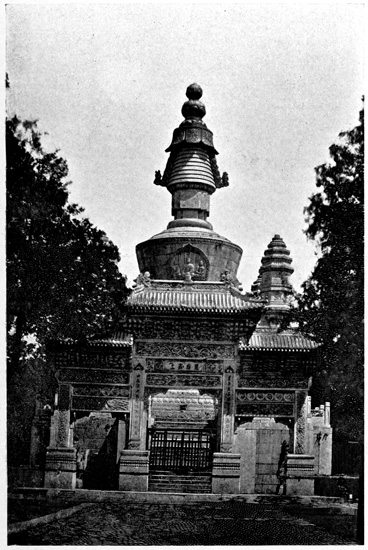
Even the tomb erected to the Banjin Lama at the Hoang Ssu (Yellow Temple) repelled me, in spite of intricate marble carvings, considered well worth the seeing. The workmanship was good, but the outline was simply hideous. Not even purple-blue sky, and golden sunshine, and old fir-trees, with golden-balled persimmons nestling beside them, relieved it from its native ugliness. But alongside of it was a great two-storied building in true Chinese style, that we indeed admired. It stood four-square, with a grandly massive porte-cochère, answering all the purposes of a verandah, so vast was it. We looked at the simple, graceful curves of its two stories of roofs, the upper definitely but only slightly smaller than the lower, and wished that, when it fell to our lot to own a house in China, 479it might be after this model. For two stories seem advisable for health, and nothing could surpass in roof-grace those grand curves, modelled, it is said, upon the upturning boughs of forest trees, though more probably upon the tent of former ages.
近年来,北京的“景点”几乎不对外开放。这对那些为了参观这些景点而前来的游客来说,是一件令人遗憾的事。但我不确定这是否也是一种解脱。毕竟,去参观那些能参观的地方,似乎是对自己的一种责任,但在那些地方,游客们常常会遭遇不礼貌和粗鲁的行为,甚至有时连看到的景点也未必值得一提。无论如何,天坛近年来一直关闭——那个至今仍按照最古老的仪式由皇帝代表他的人民进行祭祀的庙宇。先农坛关闭了;钟楼和鼓楼也是如此;夏宫仅存的部分据说也关闭了。我们甚至未能进入考试院。而他的一个好友则建议我们不要尝试进入藏传佛教寺院,因为那里居住着活佛,据说喇嘛们非常无赖。他们会为每一个新的大门索要高额费用;他们会强行拉住游客,最终索要他们所愿意支付的费用,才肯放他们出去。那部令人震惊的恐怖小说《燕子的翅膀》只是稍微夸张了一下一个游客可能会经历的事情。我们骑马到门口,看到外面的喇嘛以为我们要进去的表情,就已经足够了。我曾经研究过那不勒斯神父的表情,但与这些喇嘛相比,他们的表现简直不值一提。这些喇嘛不仅显得粗野而凶狠,还带有一种明显的无礼。他们当然会加倍索取费用,并且在游客中有女性时更加无礼。至于活佛,只有以朝贡者的身份带着礼物才能接近:一瓶白兰地、一磅糖和一罐亨利与帕尔默的混合饼干(加糖的),据说是最受欢迎的礼物。我们曾考虑把这些信息发给亨利与帕尔默公司作为广告用途。但即使有饼干和白兰地,也需要进行大量的安排,这一切都需要时间。而且,毕竟,活佛也只是偶尔像雕像一样接见人,其他时候,他像其他藏人一样接待访客。而是否愿意与藏人交往,除了传教目的之外,也是一个问题。对中国人来说,佛教是一种纯净而人道的宗教,但藏传佛教已经被他们转变成了极其粗俗的东西,似乎他们的神灵都不堪入目;婚姻之神不可能展示给一位女士,就像那位收集了中国、印度和西藏雕像的俄罗斯绅士所说的一样!中国的神像都适合任何人观看,他们的经典也适合任何人阅读;印度的神像则有些可疑;而西藏的神像则毫无疑问是令人无法接受的,他只是要求我不要再深入他的博物馆,因为我的丈夫正在查看这些神像。即便如此,我仍然不禁想到,生活在这些可怕的神像环绕之中,他的整个客厅都摆满了这些东西,必然会对这个不幸的人物性格产生影响。当我站在这些神像中间时,似乎有一种邪恶的力量从中散发出来,后来这个不幸的收藏者的经历也证实了这个理论;几年后,他因某种罪行被中国海关解雇,不久后便去世了。这些收藏品被德国的一个博物馆买下了。希望这些可怕的西藏神像现在没有在毒害蓝眼睛的德国人。
用于神圣仪式的藏传佛教乐器是用处女的骨头制成的(我们被告知这些处女是特意被杀害的,但我对此表示怀疑);他们的圣杯则是用人的头骨制成的。他们更喜欢用每个珠子都是由人的头骨碎片制成的念珠,因此每一块骨头都代表了一条人命。他们的神像则被描绘成身穿人皮,腰间挂满了人头。我被允许看到的这些内容只是这座神奇的神像和祈祷机器收藏品的一部分,其中中国的神像或温顺虔诚,或粗鲁愉快,坐在纤细优雅的印度神像和残忍恶魔般的西藏神像旁边。毕竟,没有一个民族的神的形象会高于这个民族,但至少通常认为它会与这个民族相当。根据他们的神像来判断,我当时认为还是远离藏传佛教喇嘛比较好——没想到后来我有幸深入西藏,亲眼见识到了喇嘛们如何粗暴地对待我。
即使是黄寺内为班禅喇嘛建造的坟墓也令我感到厌恶,尽管那些复杂的大理石雕刻据说非常值得一看。虽然工艺精湛,但轮廓简直丑陋不堪。即使在紫蓝色的天空和金色阳光下,伴着古老的松树和金黄色的柿子树,也不能掩盖它本身的丑陋。但是在旁边有一座真正中国风格的两层建筑,我们确实很欣赏。它四四方方地矗立着,有一个宏伟的门廊,几乎可以用来做走廊,因为它实在太宽敞了。我们看着它两层屋顶那简单而优雅的曲线,楼上明显但仅仅略小于楼下的那一层,心中希望有一天能够拥有这样一栋中国风格的房子。两层楼似乎对健康更为有利,而那些优美的屋顶曲线,无论是模仿森林树枝的上翘形状,还是早期帐篷的样式,都无与伦比。
TOMB OVER BANJIN LAMA'S CLOTHES, BUILT AFTER TIBETAN MODEL OF MARBLE. BELL-LIKE CUPOLA AND UPPER ORNAMENTS OF GOLD. INSCRIPTIONS IN DEVANAGARI CHARACTER, SANSCRIT, AND CHINESE.
The Confucian Temple, where there are tablets to Confucius and his four great followers, may be called a satisfactory sight, and has remained open of late years. Viewed as a picnic place, it is delightful. The vast courts, with their old, old fir-trees, gave me far more pleasure even than the marble balustrades, or the ancient granite so-called drums we had gone to see. But even there the behaviour of the people was what anywhere else one would call insolent in the extreme. The importunity, sores, and dirt of the Peking gamins render them also a detestable entourage. Things reached their climax, however, at the Hall of the Classics. The open door was as usual banged to in our faces, as we came near; and we were then asked through the closed door how much we would give to get in. Then as soon as we got in, all the detestable rabble following us were let in too, much though I begged they might be kept out. I do not think I had up to that time seen anything so neglected and dilapidated as the Hall of the Classics, the building in all China which one would most expect to see kept in good order, nothing being so much esteemed in China as learning, and especially the learning of the ancients. Some workmen, with almost no clothing, were apparently employed in making it dirtier; but480directly we entered they left off doing whatever it was, and devoted themselves to horse-play of the coarsest description, standing upright on their hands, pirouetting their feet over the heads of the crowd who came in with us, knocking some of them down, and rolling them in the dust. They even went so far as to sit down in their more than semi-nude condition on the same bench on which I was sitting, and as near me as possible; whilst all the while there was such a shouting and noise, it was impossible for my husband and me to speak to one another.
It is all very well to remind oneself one is in the presence of a great work, and to try and feast one's soul upon proportions and perspectives in the presence of such lewd behaviour of people of the baser sort. To put it prettily, I was distracted by a great pity for people whose chances in life seemed to have been so small; in plainer English, my temper began to rise. The porcelain arch we had come to see was certainly beautiful, a masterpiece, but not soul-satisfying. We duly noticed the elaborate eaves, protected by netting from the birds. But then came the usual question: How much would we pay to get out? They locked the door in our faces, demanding more money before they would let us out. My husband could stand no more. He was just recovering from a dangerous illness; but he took up a big beam, and smashed open the door. It fell, lintel and all, and the latter so nearly killed a child in its fall the crowd was awed. This just gave us time to get on our 481donkeys. Then Babel broke loose again, and the storm continued till we had ridden half an hour away, our donkey-men nearly indulging in a stand-up fight in the end, one of them brandishing at the other a very gracefully carved sceptre, that I had just picked up at a fair, to my intense delight. "A nice fellow you are," shouted one to the other. "You ate up all the biscuits, and now you don't know the road. You are worth nothing at all." So that was the way the biscuits had disappeared: the donkey-men had levied toll on our luncheons, and we had suspected the Peking gamins. As there are other porcelain arches in Peking, it might be as well for other visitors to avoid the Hall of the Classics altogether, we thought.
It is horrible to write expressing so much dissatisfaction in the presence of the far-famed masterpieces of a great empire, and the more so as we were very sorry to be leaving Peking, and should much have liked to spend a winter there, studying it all more thoroughly. But Sir Harry Parkes, when he came back to it, said it was returning to "Dirt! Dust! and Disdain!" and the only objection the passing traveller would be likely to make to this sentence is that it might contain a few more D's.
孔庙,这里供奉着孔子及其四大弟子的牌位,可以说是一个令人满意的景点,近年来一直对外开放。作为一个野餐地,它是令人愉快的。那广阔的庭院,古老的松树,比起我们去参观的那些大理石栏杆和古老的花岗岩所谓的鼓,更让我感到愉悦。然而,即便在这里,人们的行为在其他地方会被认为是极其无礼的。北京的小流氓们的纠缠、溃疡和肮脏使得他们成为一个令人厌恶的伴随。而事情在国子监达到了高潮。我们接近时,正如往常一样,敞开的门被猛地关在我们面前,然后通过紧闭的门问我们愿意付多少钱才能进去。当我们终于进去后,那些讨厌的乌合之众也被放了进来,尽管我再三请求把他们挡在外面。我想,在那时之前,我从未见过如此被忽视和破败的建筑。作为全中国最受尊重的建筑之一,国子监本应保持良好的秩序,毕竟在中国,学问尤其是古代学问是最被看重的。一些几乎没有穿衣服的工人,显然在制造更多的脏乱,但我们一进入,他们就停下手中的活,开始进行最粗俗的打闹。他们用双手撑地,脚在头顶上方旋转,将人群中的一些人撞倒在地,并在尘土中打滚。他们甚至在我坐的长凳上,几乎半裸的坐在我旁边;整个过程中,吵闹声和喧哗声不断,我和丈夫根本无法交谈。
在如此下流的行为面前,很难提醒自己身处伟大作品的面前,尝试用比例和透视来满足心灵。为了表达得文雅些,我因对这些人生机会如此渺茫的人感到深深的同情而分心;用更直白的语言,我的脾气开始上升。我们来参观的瓷拱门确实美丽,是一件杰作,但并不令人心满意足。我们注意到了那些用网罩住以防鸟类的复杂屋檐。但随后又出现了那个老问题:我们要付多少钱才能出去?他们把门锁在我们面前,要求更多的钱才肯放我们出去。我的丈夫再也忍不住了。他刚刚从一场危险的疾病中康复,但他拿起一根大梁,砸开了门。门框和门柱几乎砸到一个孩子,这一举动震慑了人群。这给了我们上驴的时间。随后,混乱再度爆发,直到我们骑了半个小时离开,驴夫们差点发生争执,其中一个还挥舞着我刚在集市上淘到的一根雕刻精美的权杖,让我非常高兴。“你真是个好人,”一个对另一个喊道,“你把所有的饼干都吃了,现在你还不知道路。你一无是处。”所以饼干是这样消失的:驴夫们从我们的午餐中征收了税,而我们还以为是北京的小流氓偷了。考虑到北京还有其他瓷拱门,我们觉得其他游客最好避开国子监。
在面对一个伟大帝国的著名杰作时,写下这些不满的文字确实令人痛苦,更何况我们对离开北京感到非常遗憾,非常希望能在这里过冬,更深入地研究这一切。但亨利·帕克斯爵士在回到这里时,说这是回到了“肮脏!尘土!和轻蔑!”而且过客可能会对这个评价提出的唯一异议是,它可能还需要包含更多的“D”。
The Observatory is a delightful sight—always barring the behaviour of the custodian, the most loathsome wretch I had yet encountered. And he wanted to feel me all over; did feel all over the Legation Secretary who kindly accompanied us, finally ransacking his pockets for more money than he had thought needful 482to bestow upon him. The weird, writhing bronze stands of the old instruments, with their redundancy of carving, will be for ever imprinted on my brain. Both those that stand below in a neglected courtyard, and those high above the wall, standing out against the sky, commanding the great granaries and the lovely mountains of the west, with the whole city of Peking lying in between, its courtyards filled with fine trees, giving the whole the aspect of a vast park rather than a populous city—all are beautiful. These wonderful instruments were made under the instructions of the old Jesuits, who so nearly won China to Christianity (would have done so, probably, but for the jealousy of the other religious orders), and who were for years the guides and counsellors of the Chinese Emperors. As to the outside of the pavilions within the Forbidden City, all one was allowed to see of them then, the glittering yellow Imperial roofs are like my childish idea of a fairy palace. There they stand upon their hills, dotted about among the trees, so glittering and graceful, I thought I should never tire of riding past the Green Hill, across the Marble Bridge.
天文台是一处令人愉快的景点,除了看守人的行为令人作呕之外,我从未遇到过如此令人厌恶的家伙。他试图全身摸索我,还真的全身摸遍了好心陪同我们的使馆秘书,最后翻遍了他的口袋,想要更多的钱。那些古老仪器的诡异、扭曲的青铜支架,上面繁复的雕刻,将永远印在我的脑海中。那些在下面被忽视的庭院中的仪器,以及那些高高耸立在城墙上,映衬着天空的仪器,俯瞰着西边的巨大粮仓和美丽的山脉,整个北京城尽在其中,其庭院里满是高大的树木,使整个城市看起来更像一个广阔的公园,而不是一个人口稠密的城市——所有这些都非常美丽。这些奇妙的仪器是根据旧时耶稣会士的指示制作的,这些耶稣会士差点就将基督教传入中国(可能本来就会成功,但被其他宗教团体的嫉妒所阻挠),他们多年一直是中国皇帝的指南和顾问。至于紫禁城内亭阁的外观,那时我们被允许看到的,闪闪发光的黄色皇家屋顶就像我童年时对仙宫的想象。它们矗立在山丘上,散布在树木之间,如此闪闪发光、优雅,我觉得我永远不会厌倦骑马穿过绿丘,越过大理石桥。
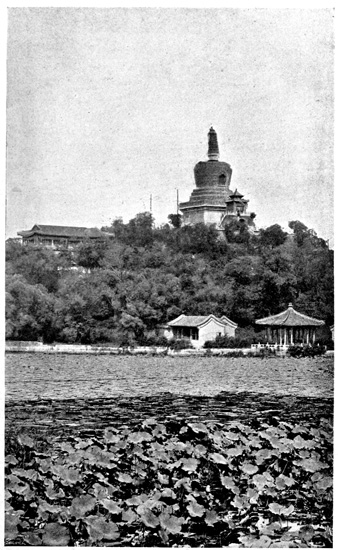
LOTUS POND AND DAGOBA IN EMPEROR'S GARDEN. Lent by Mr. Willett.