House-boat on the Peiho.—Tientsin.—Chefoo.—A Peking Cart.—Camels.—British Embassy.—Walking on the Walls.—Beautiful Perspectives.
It was in 1888 we first arrived in Peking, and we felt at once convinced that, whatever wonders it might have to offer, nothing—no! nothing could surpass the wonder of the journey. And when it is considered that every high official throughout the empire had to travel this same way in order to be confirmed in each appointment, the wonder of it is enhanced. From Tientsin you could always ride to Peking, if you were strong enough. Sir Harry Parkes did it in the day, the year before he died. But if not equal to riding eighty miles at a stretch, or eighty miles relieved (?) by nights at Chinese inns, you had in 1888 to travel the way we did, taking boat up the Peiho as far as Tungchow.
We left Tientsin at two o'clock on Thursday, and reached Tungchow at 9 p.m. on Sunday, having been very lucky, as it appeared. We had a south-west 458wind all Friday, spinning us along certain reaches of the ever wriggling, rather than winding Peiho. Along the reverse reaches the men had to tow or pole us. On Saturday the wind was so high that we had to lie to in the middle of the day, the men being unable to make any way against it by towing. And we only made a very few miles that day. In the afternoon it rained, and was altogether cheerless. But on Sunday we had a fine westerly wind blowing us on. Although a river, the Peiho in this part of its course is decidedly more canal-like and uninteresting than the English canal down which I had had some thought of travelling the year before, till I decided it would be too tedious. But after all there is a charm about this exceedingly slow method of progression. The world does not really stand still with you, but you feel as if it did. You get interested in the boats you pass and meet; some coming down stream, laden with plants in pots—two dwarf orange-trees, with oranges on them, I saw once—or bringing down straw braid, or taking up brick tea—such quantities of brick tea, which had, I suppose, come all the way down the Yangtse from poor water-beleaguered Hankow of the willow avenues and ravening mosquitoes, and round farther by sea from Shanghai to Tientsin, and whose progress on strings and strings of dignified camels Siberiawards we subsequently saw. What brick tea costs in the original instance I do not know. But when I think of the labour expended on its transport I feel it ought to be precious indeed to the Siberians.
在北運河上的船屋——天津——煙台——北京的馬車——駱駝——英國大使館——在城牆上行走——美麗的透視圖。
我們在1888年第一次抵達北京,立刻就感到,無論北京有什麼奇觀,沒有什麼——沒有什麼能超過這趟旅程的奇妙。當考慮到整個帝國的每一位高級官員都必須通過這條路線來確認每一個任命時,這奇妙感就更加增強了。從天津你可以騎馬到北京,如果你夠強壯的話。哈里·帕克斯爵士在他去世的前一年就這樣做了一天的行程。但如果你無法一口氣騎馬八十英里,或者不願意被中國客棧的夜晚打擾,那麼在1888年,你不得不選擇我們的方式,乘船沿著北運河一路到通州。
我們於星期四下午兩點從天津出發,並在星期天晚上九點抵達通州,這被認為是非常幸運的。我們在星期五有著西南風,沿著北運河的某些河段迅速前行。在逆流的河段上,人們不得不拖曳或用篙撐船。星期六風太大,我們中午不得不躺下來休息,因為人們無法在這種風中拖曳前行。我們那天只前進了很少的距離。下午還下起了雨,整個氣氛非常陰沉。然而在星期天,我們迎來了一陣西風,推動我們前行。雖然這是一條河流,但北運河在這一段更像運河,並不像我去年考慮過的英國運河那樣有趣,最後我覺得那會太枯燥。但這種極其緩慢的前進方式確實有一種魅力。你感覺世界並未真的停滯不前,而是你自己感覺停滯不前。你會對過往的船隻產生興趣;一些船順流而下,載著盆栽植物——我曾見過兩棵有橘子的矮橘樹——或者帶著稻草編織物,或者帶著磚茶往上走——如此多的磚茶,這些磚茶可能從被水圍困的漢口經過長江一路運來,然後再由上海經海路到達天津,我們後來看到了這些磚茶在成串成串的駱駝隊上向西伯利亞進發。我不知道磚茶在最初階段的價格是多少,但當我想到其運輸過程中所花費的勞力,我覺得它對西伯利亞人來說應該是非常珍貴的。
461
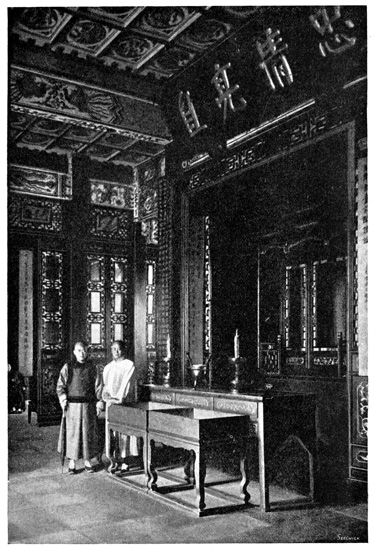
INTERIOR OF GOVERNOR'S OFFICIAL RESIDENCE AT HANGCHOW.
Every now and then we got out and walked along the banks, looking backwards at the long zigzagging procession of boats behind us, each with one large sail, or at times each with a bare mast, looking like a long line of telegraph-poles. And beside us was the line of real telegraph-poles, forerunners of the coming railway that has since been opened; and we knew that the foreigners who would approach Peking in the old historic manner were already numbered. For there will be nothing to tempt people to provide themselves with all the necessaries of life for a three or four days' trip, now that the railroad is open and you can book direct. There is nothing to be seen upon the road that cannot be seen as well elsewhere,—mudbanks, sandhills, millet- and sorghum-fields with poor crops, fairly nice trees, fences gay with convolvulus flowers, mud houses, mud roofs, and level mudbanks crowded with all the disreputable refuse of a poor Chinese village; then wood-cutters (one or two substantial coffins stood out prominently alongside of them; wood seems too precious for anything but coffins in those parts), a mule and a pony ploughing, or a donkey or an ox, never a pair of animals of the same kind. All these one looks at with a pleasant interest as one saunters or floats by. But you can see them elsewhere; or you can never see them, and yet be none the worse for the miss.
It is true that by the old method you could shut yourself into the boat cabin, and study colloquial Chinese according to Sir Thomas Wade, or write letters462home to say how you were enjoying yourself, or drink tea, or smoke, just as your previous way of life disposed you to act, there being no restraining influence further than the size of the cabin. A native boat is not quite as luxurious as a Shanghai house-boat, though it is well enough, except in the matter of its being impossible to open the cabin door from the inside. So that when we were shut in, I always thought how, if the boat should heel over, we should be drowned inside like mice in a trap. Another exception must be made—not in favour of the cracks which grow portentously larger, as the boards shrink with the increasing dryness of the air, and which must let in an inordinate draught in winter, when the air is more cold than kindly. Even towards the end of September we found it hard enough to keep warm at night. We had two cabins, but one was pretty well all bedstead, being a raised ottoman sort of a place, under which boxes could be put, and on which mattresses were laid. We had to provide ourselves with everything we wanted, even to a cooking-stove. But then we paid only nine and a half dollars for our boat, including drink money. This at the then rate of exchange was under thirty shillings. The men fed themselves. So did we. It is tiresome that, travelling in China, nothing is to be bought by the way, beyond chickens and eggs, and sweet potatoes (delicious!) and cabbage (horrible!). It is tiresome, also, that the makers of tinned things do not put dates upon their tins; therefore in the outports—which Shanghai fine ladies always pronounce as if they were 463only peopled by "outcasts"—people have to put up with the tinned milk that somehow did not sell at Shanghai. It is a pity that the local representatives of the Army and Navy Stores do not see to this, and put dates on their tins. It would be well worth the "outcasts'" while to pay extra for recently tinned butter and milk, if they could rely upon the dates. As it was, our milk was very nearly butter, though it could not quite be used for that, and it certainly was not milk.
每隔一段時間,我們會下船在岸邊散步,回頭望著那條彎彎曲曲的船隊,每艘船上都有一張大帆,或者有時候只是一根光禿禿的桅杆,看起來像一排長長的電線桿。在我們身邊則是一排真正的電線桿,是即將開通的鐵路的先鋒;我們知道,以這種古老的歷史方式進入北京的外國人已經屈指可數了。因為鐵路開通後,沒有人會再有興趣為三、四天的旅程準備所有生活必需品,現在可以直接買票乘火車前往。沿途沒有什麼是你不能在別處看到的——泥堤、沙丘、種植著黍米和高粱的田地、尚可的樹木、開滿牽牛花的籬笆、泥屋、泥屋頂,以及擠滿了貧窮中國村莊所有不名譽廢物的平坦泥堤;然後是伐木工人(一兩個顯眼的棺材站在他們旁邊;在那些地方,木材似乎除了做棺材外沒有其他用途),一匹騾子和一匹小馬在耕地,或者是一頭驢子或一頭牛,從來不會有兩頭同類的動物搭配一起。這些景象你在漫步或漂流時都會愉快地欣賞,但你也可以在別處看到這些景象;或者你從未見過這些景象,卻不會因此有任何損失。
確實,用這種老方法旅行,你可以把自己關在船艙裡,根據湯瑪斯·韋德爵士的說法學習漢語會話,或者寫信回家告訴他們你如何享受旅程,或者喝茶,或者吸煙,完全取決於你以前的生活方式,唯一的限制就是船艙的大小。當地的船不如上海的船屋那麼豪華,但除了從內部打開船艙門不可能之外,還算不錯。因此,每當我們被關在裡面時,我總會想,如果船翻了,我們就會像陷阱裡的老鼠一樣被淹死。還有一個缺點是不利於那些隨著空氣越來越乾燥而縮小的板條,這些板條的裂縫會越來越大,冬天時會讓大量的冷風灌進來。即使在九月底,我們晚上也很難保暖。我們有兩個船艙,但其中一個幾乎全是床架,是一個抬高的沙發床,下面可以放箱子,上面鋪著床墊。我們必須自己準備所有需要的東西,甚至是爐灶。但我們的船費只需九個半銀元,這包括了小費。按照當時的匯率,這不到三十先令。船夫們自己養活自己。我們也一樣。在中國旅行,沿途只能買到雞和雞蛋、紅薯(非常美味!)和白菜(非常難吃!),這一點很讓人困擾。還有一件麻煩事是罐頭食品的生產商不在罐頭上標明日期;因此,在外港——上海的上流女士總是把它們的發音搞成「被流放者」居住的地方——人們不得不忍受那些在上海沒有銷路的罐頭牛奶。很遺憾,當地的陸軍和海軍商店代表沒有注意到這一點,沒有在罐頭上標明日期。對於「被流放者」來說,支付額外費用購買新鮮罐裝的黃油和牛奶是值得的,只要他們能夠依靠這些日期。至於我們的牛奶,它幾乎變成了黃油,雖然不能完全當作黃油使用,但肯定不能當作牛奶。
The Concession at Tientsin is either so far away from the Chinese town, or so satisfactory to its inhabitants, that they never stray away among the Chinese. On landing at the bridge of boats in the native city, while our servants made a few purchases, I found I excited as much interest as if there had not been a European colony within a thousand miles. It was, however, a particularly friendly crowd that accompanied me. A boy danced in front, clapping his hands, as if to bid the people in the street make way; another boy was very eager to point out all the sweet cakes he thought nicest; two old women and an old man went down on their knees to beg; an old man was washing very old shoes upon the bridge; another was selling odds and ends of old things, that looked as if they never had been new. There were sweet potatoes cooking; there were various other buyers and sellers, and crowds passing by, both on foot and in boats. Sometimes the bridge would be opened, sometimes closed to let the foot passengers go by. There was 464always a crowd; whichever way of progress was open, people were always progressing by it before it was ready for them. Nobody pushed, nobody was rude; every one appeared pleasant. But there, looking down the long straight reach of the river, was the tall tower of the ruined Roman Catholic Cathedral, recalling the massacre of 1870—a massacre that might so easily have embraced all the Europeans in the Concession, had not the rain mercifully come down in torrents and dispersed the mob. It did not seem possible, when we were there, to think of any danger of the kind threatening the exceptionally thriving-looking settlement.
I have not seen any Concession yet I liked the look of so well as that of Tientsin. There is a go-ahead look about the place, with all its goods stored in heaps on the Bund with only matting over them, instead of, as elsewhere, in warehouses; which makes it contrast especially with Chefoo, that sleeping beauty, whom no fairy prince has yet awakened. Perhaps, when he does, the merry wives of China, who used to resort there every summer, may find it hardly as charming as it was in its tranquillity and freedom from all restraint. But it was so tranquil, so absolutely uneventful, that our summer month there seemed only like a dream to look back upon. Its coast-line is beautiful; but it is a coast-line with nothing behind it, as it were—like the cat's smile in Alice in Wonderland, a grin and nothing more.
But it was at Tungchow in the old days that the tug of war in getting to Peking used to begin. You had 465bought all your stores, and furnished your boat, and spent days and nights in it; but all that was nothing to the great business of getting to Peking. There were thirteen miles yet to do, and the question was, How did you mean to try to get over them? My own firm conviction now is that the easiest way would have been to get up very early in the morning and walk. But as it was, I came into Peking in the traditional style, feet foremost in a springless cart, holding on hard to either side. We started at eleven in the morning from Tungchow, paused for an hour at a wayside inn to eat and rest, and did not reach Peking till six, only just before the gates were closed. At first starting I thought the accounts of the road had been exaggerated. It is true it was so dusty at intervals I was more reminded of a London fog than anything else. It is true I could not leave go with either hand without getting a tremendous bump on the head. But still I did not think the road was quite as bad as I had expected. Alas! the road was so bad we had not started by it at all, but were simply getting along by a way the carts had made for themselves. At Pa-li Chiao we came upon the real grand stone road, with the grand bridge made by the Ming Dynasty—when they moved their capital from Nanking to Peking, in order better to repel invading Tartar hordes—and never in the centuries since repaired by the Tartar horde of Manchus, who at once conquered them, when they thus obligingly put themselves within easy reach at the very extreme limit of their vast empire.
租界与中国城的距离甚远,或是对其居民来说非常满意,以至于他们从不离开租界去到中国城。当我在本地城市的浮桥上登陆时,仆人们去采购了一些物品,我发现自己引起了极大的兴趣,就好像在千里之外没有任何欧洲人的殖民地一样。然而,伴随着我的是一群特别友好的群众。一个男孩在前面跳舞,拍手,仿佛在告诉街上的人让开;另一个男孩非常热心地指出他认为最好吃的甜糕点;两个老妇人和一个老汉跪下来乞讨;一个老汉在桥上清洗着非常旧的鞋子;另一个在卖各种旧物,似乎这些东西从未是新的。那儿有正在煮的红薯;还有其他买家和卖家,来往的人群,不论是步行还是乘船。有时桥会打开,有时关闭以便行人通过。人群总是存在,无论哪种通行方式开放,人们总是在准备好之前就已经开始通过。没有人推搡,没有人粗鲁;每个人看起来都很愉快。然而,顺着河流望去,那高耸的塔楼——破败的天主教堂,令人想起1870年的大屠杀——那场屠杀本可以轻易地包括所有租界内的欧洲人,若不是倾盆大雨仁慈地降下,驱散了暴徒。当我们在那里时,似乎不可能想到会有任何此类危险威胁到这个看起来格外繁荣的定居点。
我还没有见过比天津租界更让我喜欢的租界。这个地方有一种进取的气息,所有的货物都堆放在码头上,只盖着草垫,而不是像其他地方那样存放在仓库中;这使得它与烟台形成了鲜明对比,那座沉睡的美人,还没有被任何仙王子唤醒。或许,当仙王子来临时,以前每年夏天都会去那里的中国夫人们会发现它不再像原来那样迷人,失去了它的宁静和无拘无束。但它是如此宁静,如此绝对无事发生,我们在那里的夏月回想起来就像是一场梦。它的海岸线很美,但却是一条没有任何背景的海岸线——就像《爱丽丝梦游仙境》中的猫的笑容,只剩下笑容,别无其他。
然而,在过去的日子里,真正的挑战是在通州开始的。你已经买好了所有的储备物资,装备好了你的船,并在船上度过了几天几夜;但这都不算什么,真正的大事是如何到达北京。还有十三英里要走,问题是,你打算如何走完这段路?我现在坚定地相信,最简单的方法是很早起床然后步行过去。但实际上,我是以传统的方式进京的,脚朝前坐在没有弹簧的马车里,两边紧紧抓住。我们上午十一点从通州出发,在路边的一家小店停留了一个小时吃饭和休息,直到六点才到达北京,正好在城门关闭之前。刚开始的时候,我觉得对道路的描述有些夸大。确实,有时的尘土让我想起伦敦的雾霾。确实,我不能松开任何一只手,否则会重重地撞到头。但我仍然不觉得路比我预期的要糟糕。不幸的是,路况实在太差,我们根本没有走在主路上,而是沿着马车自己开辟的路前进。在八里桥,我们来到了真正的宏伟石路和明朝建造的大桥——当时他们将首都从南京迁到北京,以更好地抵御鞑靼人的入侵——在随后的几个世纪里,满清鞑靼人入侵并征服了他们,这条路也从未得到修复。