Monastery near Ichang.—For the Dead.—Near Ningpo.—Buddhist Service.—T`ien Dong.—Omi Temples.—Sai King Shan.—Monastery of the Particoloured Cliff
Monastery near Ichang.—For the Dead.—Near Ningpo.—Buddhist Service—T`ien Dong.—Omi Temples.—Sai King Shan.—Monastery of the Particoloured Cliff.
宜昌附近的寺院 —— 為死者而建 —— 寧波附近 —— 佛教儀式 —— 天洞 —— 鳥見寺 —— 西京山 —— 斑崖寺
The country round Ichang has always some special beauty, and in autumn it is the tints, shown to especial advantage on the tallow-trees. But one day we gathered by the wayside lovely anemones, still lingering on in sheltered spots; large gentians, with their edges picked out into delicate feathery streamers such as one finds in picotees, the little yellow originator of all the garden chrysanthemums; China asters; China daisies; the cunningly placed red berries of the spindle-tree; and branches crowded with the fairylike red berries of the Chinese hawthorn. And yet we were in the weird, arid, conglomerate region, where, as the botanist of the party said, no flower would dream of growing that could grow anywhere else. The Cherokee roses were no longer in bloom. Are these innocent, white, large roses at the bottom of the American horror of Chinese immigration? It may be remembered that, originating from China, they spread over America with such rapidity that it was assumed they must be of 328native origin, and from their aggressive nature they were given the name, by which they are still known, of Cherokee.
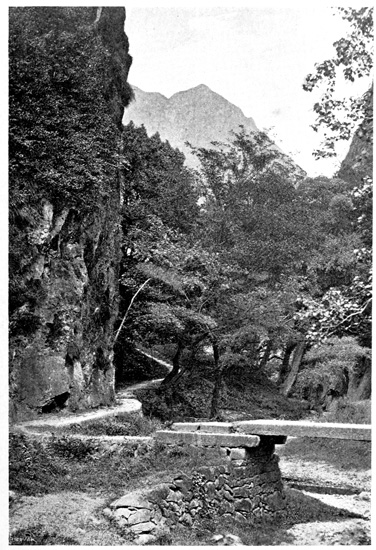
We made our way to my first monastery, so conspicuous an object to every visitor to these regions, planted on a rocky spur of about fifteen hundred feet high, that not only overhangs precipitously the country beneath, but is separated by a chasm of some one thousand feet from the adjoining hills. Crossing this chasm on a rock bridge about three feet wide, and, as usual in China, railless, required more nerve than one of our party possessed, and the subsequent climb was more trying still up the steps cut out of the steep rock on to the Buddhist temple, that appropriately crowns the whole summit, and which, were it in any more accessible region, would have been "photographed like this and photographed like that," like any professional beauty. As it was, I had never seen a picture of it, and was quite eager to take my camera to photograph the mountain-top, as also the massive wall of conglomerate rock that builds up the col one has to climb in ascending, and from which one obtains one of those extraordinary desolate views characteristic of conglomerate country—a valley ending in an abrupt gully with dry waterbed, and dry waterfalls down precipices marked with pudding-holes, all scoring parallel horizontal lines across their stern surfaces. We came across brecciated conglomerate in which there were some bits of most exquisite glistening marble, and in which we again noticed the peculiarity, that at every fracture it was the 329marble and stones, of which it was formed, that were cleft through the middle, as evidently more breakable than the apparently soft-looking red cement that bound them together.
宜昌周邊的鄉村總有一些特別的美景,秋天的色彩尤其在烏桕樹上顯得格外動人。某一天,我們在路邊採集了美麗的銀蓮花,這些花在庇蔭處仍然綻放;還有邊緣如羽毛般細緻的桔梗花,就像秋海棠上的精美花邊一樣,這些小小的黃色花朵是所有園藝菊花的始祖;中國的翠菊;中國的雛菊;精心佈置的衛矛紅果;以及滿是如童話般紅色果實的山楂枝條。儘管我們身處奇異而荒涼的礫岩區,這裡的植物學家說,沒有任何花朵會在這裡夢想生長,除非它們無法在其他地方生長。切羅基玫瑰已不再綻放。這些無辜、白色、大朵的玫瑰是否是美國對中國移民恐懼的根源?要知道,這些花源自中國,並迅速蔓延至美國,甚至被認為是本地品種,由於其侵略性,它們被冠以切羅基這個名字,至今仍然沿用。
我們前往我的第一座寺院,這座寺院對每個來訪者來說都是如此顯眼,坐落在約一千五百英尺高的岩石岬角上,不僅陡峭地懸掛在下方的鄉村上空,還與相鄰的山脈間隔著約一千英尺的深谷。我們跨過這個深谷,走在一條約三英尺寬的石橋上,而這在中國是很常見的,沒有欄杆,這需要我們其中一位成員具備更多的膽量,隨後的攀登更加艱難,沿著陡峭的岩石階梯攀登至佛寺,這座佛寺恰如其分地冠絕整個山頂。若這座寺院位於更易到達的地區,早已被「這樣拍攝,那樣拍攝」,像任何職業美人一樣。由於其位置偏僻,我從未見過它的圖片,非常渴望帶上相機拍攝這座山頂,以及構成鞍部的龐大礫岩牆。在攀登的過程中,我們可以欣賞到典型礫岩地區的荒涼景色——一條結束於突兀峽谷的山谷,乾涸的河床和乾涸的瀑布沿著峭壁下降,峭壁上布滿了布丁洞,所有這些都在其嚴峻的表面劃出平行的水平線條。我們還遇到了一些由最精美的光滑大理石構成的角礫岩,在每次斷裂處,我們都注意到這些大理石和石頭都從中間裂開,顯然比看似柔軟的紅色水泥更容易破碎,這些水泥將它們緊密結合在一起。
The way up was beautiful. We passed by picturesque farmsteads nestling in hollows, elegant shrines, and the grove the Reeves' pheasants particularly love. It is of pendulous cypress, called funebris, but suggesting anything but funereal associations by its pleasing grace. Palm-trees grew on the hillside, also bamboo, cunninghamia, ilex, and beautiful soap-trees, with the great long pods from which the soap is made, and tree-like thorns projecting from their stems, such as must effectually baffle any monkey-climbers. In four examples we saw these thorn branches had again other thorns projecting from them. The path is an easy one, carefully laid out by the priests for the convenience of pilgrims; and although there must be over five hundred steps, they do not come all together; so that few climbs of equal height can be so easily managed as that to the monastery of Yuen Ti Kuan, whose site, if paralleled, could hardly be surpassed. It is like that of some wild eyrie on which an eagle might be expected to build its nest, but where we should hardly expect practical, prosaic (so called) Chinamen to build a place of worship, simply to give themselves the further additional trouble of climbing so high. It seems that after all the Chinese have a religion of their own, which they deem holy, though it is often convenient to ignore this. There are 330many Shansi men in these parts, and one of our fellow-travellers, a man from Shansi, being asked why this was, when his province used formerly to be the granary of the empire, replied at once, "The hearts of the people have become corrupted."
As we came back, there were about four miles of little lanterns floating down the great river, sped in honour of the dead by a rich Chinese in mourning for his parents. Talleyrand's somewhat brutal "Il faut oublier les morts, et s'occuper des vivants" often recurs to me in China, where there are more grave-mounds round the city than living men inside it. The very handsome old Italian Bishop used to hate these grave-mounds, which he said oppressed him the more the longer he looked at them, and among which, alas! he was doomed to live and die.
It was near Ningpo I first assisted at a Chinese Buddhist service. We had been straying over hills pink and red and orange and mauve with azaleas in their full delicate bloom and perfect beauty. The most exquisite bush of pink azaleas hung over the great waterfall there, and caught some of the spray upon its blossoms, as the stream turned over the edge for its first leap, the flowers constantly wavering with the breeze the rushing waters brought. Wandering by lovely Windermere's side in the English Lake District, I had read Miss Gordon Cumming's description of hillsides striped and banded in colour with azaleas, and thought some day I too must see them. The seasons had rolled round but twice, and now here was I already 333tired of pink azaleas, which I decided looked too smart on a mountain-side, and preferring the big orange flowers or the deep red, or revelling in the long clusters of sweet-scented wistaria, that hung about like lovely ringlets; looking with exultation at osmundias curving their opening fronds with the full vigour and health imparted to them by the spring, and delighting in the clumps of feathery bamboos, golden stemmed old friends of my childhood; yet admiring almost equally Cunninghamia sinensis on its native heath. We plant little saplings of this last in our gardens, and boast with them even then. Here they were tall and vigorous, and everywhere giving an Oriental character to the ferns and the azaleas, the bamboos and fan-palms.
我們一路上風景如畫。經過那些依偎在山谷中的迷人農舍,優雅的神龕,以及里夫斯雉最喜愛的小樹林。這些樹林主要由垂枝柏組成,雖然名稱帶有哀悼之意(funebris),但其優雅的姿態卻給人一種愉悅的感覺。山坡上長滿了棕櫚樹、竹子、杉木、冬青和美麗的肥皂樹。肥皂樹上結滿了製作肥皂的大豆莢,樹幹上還有樹狀的刺,這些刺必定能有效阻止任何企圖攀爬的猴子。我們看到四棵這樣的樹,每棵樹的枝條上都長著其他的刺。這條小徑非常平緩,僧侶們精心設計,方便朝聖者行走;儘管有超過五百級階梯,但並不是連續的,因此很少有與此等高的攀登能像去元蒂觀寺那樣輕鬆。這座寺院的位置無可比擬,就像一個野鷹巢,似乎鷹隼會在此築巢,但我們卻難以想像實際、平凡(所謂)的中國人會在此建造一座寺廟,只是給自己增添攀登的麻煩。看來中國人終究有自己認為神聖的宗教,儘管這經常被忽視。這些地方有很多山西人,我們的一位同行者正是來自山西,當被問及為何他們會在這裡,當他們的省份曾是帝國的糧倉時,他立即回答說:「人心已經腐敗。」
我們回來時,看到約四英里的小燈籠漂流在大河上,這些燈籠是某位為父母哀悼的富有中國人為死者而放的。塔列朗那句有些殘忍的話「我們應該忘記死者,關心活人」經常在我來到中國時浮現,這裡的墳丘比城內的活人還多。那位非常英俊的老意大利主教曾經討厭這些墳丘,他說這些墳丘壓抑著他,隨著時間的推移愈加沉重,而他注定要在這些墳丘中生活和去世。
在寧波附近,我首次參加了一場中國佛教儀式。我們漫步在滿是杜鵑花的山丘上,粉色、紅色、橙色和淡紫色的杜鵑花盛開,美不勝收。最精美的粉色杜鵑花叢懸掛在大瀑布上方,當溪水第一次越過邊緣時,這些花朵捕捉到了一些水霧,花朵隨著湍急的水流帶來的微風不斷搖曳。在英國湖區美麗的溫德米爾湖畔徘徊時,我曾讀過高登·卡明小姐對杜鵑花條紋和色帶的描述,心想有一天我也必須去看看。季節才過了兩次,如今我已經厭倦了粉色的杜鵑花,覺得它們在山坡上看起來太過鮮豔,我更喜歡大橙色的花朵或深紅色的花朵,或者陶醉於長串香氣撲鼻的紫藤花,這些花朵像美麗的鬈髮一樣懸掛;欣喜地看著長尾榕彎曲著新展開的葉片,充滿了春天帶來的生機和健康;陶醉於羽毛般的竹叢,這些金色莖幹是我童年的老朋友;同樣欣賞在它的故土上生長的中國杉。我們在花園裡種植這些小樹苗,並以此自豪。這裡的它們高大而充滿活力,處處為蕨類植物、杜鵑花、竹子和蒲葵增添了東方的特色。
NEAR NINGPO.
Then the rich, sweet tones of the Buddhist bell summoned us, and we slept, as it were prisoned, within the dark precincts of the monastery, not even through latticed windows catching any glimpse of outside glories, till solemn sounds roused me in the early dawning, and I stole in at the back of the dark temple, and could hardly believe I was not in one of the Portuguese churches of my childhood. There knelt the priests, with close-shaven heads, and long cloaks broached across the left breast, leaving the right arm bare, and formed of little oblong bits of old gold or ashen grey linen, neatly stitched together, thus symbolising at some expenditure of pains the poverty of rags. They prostrated themselves three times, touching their foreheads to the ground—before the altar, was it not? They bowed and knelt before the altar! They elevated 334the Host, or at least a cup, one ringing a bell meanwhile, the others prostrate in adoration. Could the resemblance be more perfect? They chanted a monotonous chant—it sounded to me just like a Gregorian—and after many bowings and prostrations and beatings of a dull wooden gong in the form of a skull, processioned round and round before the altar, bowing as they passed, each a rosary at his side, and solemnly chanting. There seemed to be no doubt about the words; I heard them quite distinctly: "Domine, ora pro nobis, ora, ora." Then "Gloria! gloria!" swelled out. And meanwhile, though passing me at intervals so closely I almost felt the frou-frou of their robes, not a priest there seemed to perceive my presence, but all went by with eyes on the ground, fingers and palms close pressed together. A strange feeling came over me, as if I were dreaming. Had the azaleas intoxicated me? Was I in far-away Madeira of my childhood? Were those not Portuguese Roman Catholic priests, not Chinese Buddhists? Were they praying really? To our Father in heaven? Or are there more gods than one? If not, they were worshipping, and I was not. And had this worship gone on after this fashion for thousands of years, before even Christ walked the earth, and lived and died for man? I knelt in prayer behind the Buddhist priests. And then I saw the figure of the Virgin with the Holy Child upon her knee. They call her Kwanyin (Goddess of Mercy).