Tseng Kuo Fan.—"Neither envious nor fawning."—Repose of Manner.—Cultivation of Land.—Early Rising, Diligence in Business, and Perseverance.—Dignity.—Family Worship.—Reading
Tseng Kuo Fan.—"Neither envious nor fawning."—Repose of Manner.—Cultivation of Land.—Early Rising, Diligence in Business, and Perseverance.—Dignity.—Family Worship.—Reading.
曾國藩——“不忌妒,不諂媚”——儀態安詳——耕種土地——早起、勤奮、堅韌——尊嚴——家庭敬拜——閱讀
Some extracts from a Chinese father's letters to his son will probably do more to explain what is thought admirable in a Chinese young man than pages of commentary. The son in this case was the late Marquis Tseng, during many years Chinese Minister in London. The writer was his father, the celebrated Tseng Kuo Fan, in whose honour a temple has been put up at Wuchang opposite Hankow. Grandson of a Hunan farmer, son of a humble scholar, this Chinese Chesterfield passed his first examination at twenty-one; and continuing steadily to pass examinations, he was a Hanlin student at twenty-eight, Chief Examiner for the Province of Szechuan at thirty-two, Deputy-Supervisor of Instruction in Peking, and nominally in charge of the education of the future Emperor at thirty-four. During the Taiping rebellion he had to become a General; and it was during all the troubles of this rebellion his letters were written. It was his devoted brother, then a Viceroy, who published the Life and 318Writings of Tseng Kuo Fan. The latter, just as his son was becoming a man, wrote to him as follows:
"From my earliest years I have been a student of the ancient sages. Among their thousand words and myriad sayings there is no sentence more striking or suggestive than the little phrase of four characters, pu chi, pu chin* (neither envious nor fawning). *Chi* means to be envious of the virtuous, and malignant towards the influential. The fact that any one lacks the spirit or the ambition to walk in the path of rectitude is no reason why he should be afraid of the success of others. *Chin means that you will sink all to gain name and wealth, and then be in a constant state of unrest lest these treasures should be lost. Such a disposition as either the former or the latter is the characteristic of the 'small man.' As Viceroy of Chihli I constantly see men of equal rank and abilities manifesting a spirit of envy, animated only by the spirit of self-seeking and suspicion. If you desire to secure happiness in this life, you must get rid of the spirit of envy. If you desire to act properly and set a good example, you must abhor the character of the sycophant. The one leads to the other's injury, and the other is the spirit of the robber. I dare not affirm that I have swept my heart of these two evils; but I wish, nevertheless, to warn you and your brothers of these deformities."
Here is a characteristic bit of Chinese advice:
"With regard to your walking, I observe that your manner is too animated. Are you more quiet now? Your utterance is also far too rapid for clearness of321pronunciation. You should cultivate more repose of manner. Are you improving in these two respects? These two cautions you are to keep constantly in mind, and see if you cannot make a change for the better."
從中國父親寫給兒子的信中摘錄一些內容,可能比長篇評論更能解釋在中國年輕人身上被認為值得稱讚的品質。在這個例子中,兒子是已故的曾侯,曾任多年駐倫敦的中國大臣。寫信的是他的父親,即著名的曾國藩,為紀念他在漢口對面的武昌立了一座廟。這位中國的切斯特菲爾德(Chesterfield)是湖南一位農民的孫子,一位卑微學者的兒子,二十一歲通過第一次考試,並在此後持續通過考試,二十八歲成為翰林學生,三十二歲擔任四川省主考官,三十四歲成為北京的副監察官,名義上負責未來皇帝的教育。在太平天國起義期間,他不得不成為一名將軍,而這些信件就是在這次起義的所有困難時期寫的。是他獻身的兄弟,當時的一位總督,出版了《曾國藩的生平和著作》。在他的兒子剛成年的時候,他寫信給他如下:
“從我早年起,我就是古代聖賢的學生。在他們的千言萬語中,沒有一句比‘不忌,不諂’這四個字更引人注目或更有啟發性。‘忌’意味著嫉妒賢能,對有權勢的人懷有惡意。任何人缺乏正直的精神或抱負,都不是他應該害怕他人成功的理由。‘諂’意味著為了名利可以放棄一切,然後處於不斷的焦慮狀態,擔心這些財富會失去。這兩種性格都是‘小人’的特徵。作為直隸總督,我經常看到同等地位和能力的人表現出嫉妒之心,只是因為自私和猜疑的精神。如果你想在這一生中獲得幸福,就必須擺脫嫉妒的精神。如果你想正確行事並樹立良好的榜樣,就必須厭惡諂媚的性格。一種行為導致他人的傷害,而另一種行為則是強盜的精神。我不敢說我已經完全掃除了這兩種惡習;但我仍然希望提醒你和你的兄弟們注意這些缺陷。”
這是一段典型的中國式忠告:
“關於你的走路,我注意到你的姿態太過活潑。你現在是否更安靜了?你的言語也太過快速,影響了發音的清晰度。你應該培養更多的安詳儀態。你在這兩方面有進步嗎?這兩個警告你要時常記在心中,看看你是否能做得更好。”
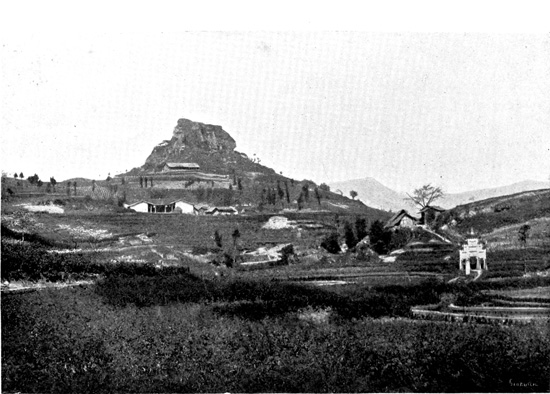
FORTRESS OF REFUGE, COUNTRY HOUSE, AND MEMORIAL ARCH. By Mrs. Archibald Little.
One has constantly to remind oneself in China that the stolidity one sees around one is assumed in accordance with etiquette, and that in reality far more emotion is felt than shown in a land where only street arabs dare to be altogether natural and smile when they see one.
In all the throes of the revolution the busy statesman yet had time to think, like Mr. Gladstone, of la petite culture:
"I think it would be well for you to select several plots of land, and devote them exclusively to the raising of vegetables. At our cantonments I have turned many of our braves into gardeners. The land has been laid out in beds thirty feet by five, separated by paths and little water-ways, so that the vegetables should not be drowned after heavy rains. In the province of Szechuan I first saw gardening of this kind. The processes of irrigation are there carried to great perfection; and they seem certainly to have caught the ideas and practice of the ancients. In our region of the country very little land is set aside for the cultivation of vegetables. I wish my family to set the precedent of taking seemingly sterile tracts of mountainous land or wet, marshy places, and making them useful in raising fruit and vegetables. Though the cultivation of tea may yield greater profit in some of the valleys, yet I 322am convinced if my scheme is carried out no one need complain of poverty in all that region. All that is needed is to be judicious and persevering."