Number of Degrees.—Aged Bachelors.—Up for Examination.—Necessary Qualifications.—Crowding.—Scarcity of Posts.—Chinese Dress
Number of Degrees.—Aged Bachelors.—Up for Examination.—Necessary Qualifications.—Crowding.—Scarcity of Posts.—Chinese Dress.
Far more formidable than the soldiery are the literati of China. Soldiering is despised in China; learning is esteemed. The literati also are far more numerous; they arrive in great armies, nominally ten thousand strong or more, and each young man of any standing has his pipe-bearer and three or more servants, possibly in the case of military students a horse or two and attendant grooms as well. In the summer of 1897 at Chengtu there were fourteen thousand candidates, who had already passed the first of the five examinations necessary before entering the highest body in China, the Hanlin College. They were all what is commonly Englished into B.A.'s; that is, Shiu Tsai, or Budding Talent. *And there were ninety-six degrees to be conferred!*Picture the disappointment in a land where for twelve centuries no official post of any kind has been conferred without preliminary examination. Men go up year after year, year after year, in many cases collecting contributions from friends 293and patrons towards travelling expenses. Sometimes these contributions are given under promise that, if the needy student do not pass this year, he will not try again. But this is a promise made to be broken. And I believe it is really true, if a man go on competing for his B.A. and failing, at the age of eighty he is considered to have passed.
In 1891 the Governor of Yunnan said that it was also permissible under certain circumstances to bring to the notice of the Throne cases of scholars well advanced in years who have failed to pass their examinations for the degree of chüjen, and begged to recommend for favourable consideration the case of Lien Hsiang-yang, a Bachelor of over eighty years of age, who had failed to pass at the last examination. He had obtained his degree of Bachelor only nine years before, and in the eyes of the memorialist his praiseworthy endeavours to scale the heights of Parnassus ought to meet with some recognition.
學位數量——年長的學士——參加考試——必要資格——擁擠情況——職位稀缺——中國服飾
比起軍人,中國的文人更為可畏。軍人在中國被鄙視,而學問則受到尊重。文人也更加數量眾多,他們成群結隊地到來,名義上有一萬多人,每個有身份的年輕人都有煙管侍從和三個或更多的僕人,軍事學生可能還有一兩匹馬和隨從馬伕。1897年夏天在成都,有一萬四千名考生,他們已經通過了進入中國最高學府——翰林院之前所需的五次考試中的第一次。他們全都是所謂的學士,即秀才,或者說“萌芽人才”。*而且有九十六個學位要被授予!*想像一下在一個十二個世紀以來沒有經過初步考試就沒有任何官職的國度裡,這樣的失望。人們年復一年地參加考試,許多情況下還要從朋友和贊助人那裡募集旅費。有時這些捐款是以這樣的承諾為前提:如果窮困的學生今年沒考過,他就不再嘗試。但這是一個會被打破的承諾。我相信這是真的,如果一個人不斷地參加學士考試並且不及格,到了八十歲,他就被認為通過了。
1891年,雲南總督說,在某些情況下,也可以向朝廷舉薦那些年事已高但未能通過舉人考試的學者。他懇請對一位名叫連向陽的學士給予特別考慮,這位學士已經超過八十歲,上次考試未能通過。他僅僅在九年前獲得了學士學位,在上奏者眼中,他努力攀登文學高峰的值得讚揚的努力應該得到某種認可。
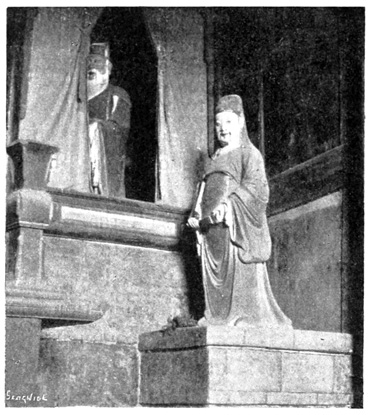
TEMPLE OF GOD OF LITERATURE. By Rev. E. J. Piper.
It is a curious method, that of a Chinese examination. The Literary Chancellor of the province travels round from city to city. Suddenly there is an influx of new faces, and the streets are full of strangers looking about them. Missionaries always say, "The students are swaggering about." When the Consul does not send out a request for Europeans to keep within-doors or to be careful, I straightway order my sedan-chair, and pretend I want to buy something near the examination-hall. Any one, who knows the monotony of always blue gowns and a slouch, would understand 294that the idea of "some one swaggering" is irresistible. But so far I have never succeeded in seeing even one military student swagger. I know the mandarin swagger, and the Tientsin swagger, which is the most audacious of all, and would make every one in Bond Street turn round to look; and I know the young merchant swagger, which is amusing, and not very unlike a very young London clubman's swagger, when he does swagger. I am afraid it a little went out when high collars came in. But the students I have seen have mostly been pale, very anxious-looking young men, who drop in at our luncheon-time, and look with great interest at our foreign things, sitting on for ever, when they find we have actually specimens of the books of that most useful Society for the Diffusion of Christian and General Knowledge. Then they turn them over and are happy, till they suddenly wake up sadly to the fact we have no more. "And I wanted to take back copies to all my friends in the 295town of ——," said one student that I know. But then he did not pass. He is a reformer, a dreamer, as the Secretaries of Legation at Peking dub all of the party of progress in China; for that city seems to deaden the very souls of the Diplomatic Corps, walled up inside it, away from all their own nationals, and full of their parties and theatricals and petty jealousies, unaware apparently that there is a great Chinese nation throbbing across some two thousand miles of country south and west.
中國的考試制度很奇特。省裡的學政大臣會從一個城市巡視到另一個城市。突然之間,街頭出現了許多新面孔,街上充滿了四處張望的陌生人。傳教士們總是說:“學生們趾高氣揚地四處走動。”如果領事沒有發出請歐洲人呆在室內或注意安全的通知,我馬上就會叫來轎子,假裝要去考場附近買東西。任何了解總是藍色長袍和邋遢打扮單調性的人都會理解,“某人趾高氣揚”這個念頭是無法抗拒的。但到目前為止,我從未見過哪怕一個軍事學生趾高氣揚。我知道官員的趾高氣揚,天津人的趾高氣揚,那是最放肆的,會讓邦德街上的每個人都回頭看;我也知道年輕商人的趾高氣揚,那很有趣,有點像非常年輕的倫敦俱樂部會員在趾高氣揚時的樣子。我擔心這種趾高氣揚在高領進來時有些消失了。但是我見過的學生大多是面色蒼白,非常焦慮的年輕人,他們在我們吃午飯時進來,對我們的外國物品非常感興趣,坐著不走,直到發現我們實際上有那個非常有用的基督教和通識知識傳播協會的書籍樣本時,他們翻看這些書,感到很高興,直到突然醒悟到我們沒有更多了,才顯得悲傷。“我還想帶一些回去給鎮上的所有朋友呢,”我認識的一個學生說。但他沒有通過考試。他是個改革者,是個夢想家,正如北京的公使館秘書們對所有中國進步黨派人士的評價;因為那座城市似乎讓外交使團的靈魂麻木,將他們困在城牆內,遠離他們的國民,滿是他們的聚會、戲劇和小嫉妒,顯然沒有意識到有一個龐大的中國民族在南方和西方跨越大約兩千里的土地上悸動著。
Then there are the brilliant students, who pass every time, and are going up for the Hanlin College. They are very much afraid of turning their attention away from the classics for a moment to look even at histories of the Japanese War or of the nineteenth century. They know all about the Röntgen rays, but they dare not be interested. They have got to pass, and to get means to do so they must teach other young men to pass preliminary examinations; and they have brought the latter up with them from some small country town, and are responsible for them. More than the weight of empire seems resting upon their young shoulders; but the fact that they come to see us, and come again, shows that they are interested in foreign affairs. To one I undertook to teach English in a six weeks' holiday last Chinese New Year season. He learnt the alphabet in two days; then he learnt easy words; but why c a t should spell cat, because b a t spelt bat, he could not imagine. The very idea of an alphabet is so strange to a Chinaman. He thinks what 296you want him to do is to learn it by heart, and he conscientiously learns it. Then when you dodge him he is mortified. As to spelling, I know no way to make him understand it, until he has learnt how to spell; till then it is a mystery to him. He was a most brilliant young scholar, who had already passed his second examination with great éclat, whom I essayed to teach, and every now and then I seemed to see glimmerings of understanding, but then again all became dark, as I tried desperately to teach him to read, so that he might go on teaching himself in his distant country town.
然後還有那些每次都通過考試,並將進入翰林院的優秀學生。他們非常害怕把注意力從經典著作上轉移開片刻,甚至不敢看有關日俄戰爭或十九世紀的歷史書籍。他們對倫琴射線(Röntgen rays)了如指掌,但不敢表現出興趣。他們必須通過考試,為了做到這一點,他們必須教其他年輕人通過初步考試;他們把這些學生從一些小鄉鎮帶來,並對他們負責。他們年輕的肩膀似乎承擔著超過帝國重擔的重量;但他們來看我們,並且再次來訪,顯示出他們對外國事務感興趣。我曾在上個中國新年假期期間答應教一位學生學英語,為期六週。他在兩天內學會了字母表;然後他學會了簡單的單詞;但為什麼“c a t”拼寫成“cat”,因為“b a t”拼寫成“bat”,他無法想像。字母表的概念對中國人來說是如此陌生。他認為你希望他做的是把字母表背下來,於是他認真地背了下來。然後當你變換教法時,他感到很懊惱。至於拼寫,在他學會如何拼寫之前,我不知道有什麼辦法讓他理解這一點;在那之前,拼寫對他來說是一個謎。這是一位非常聰明的年輕學者,已經以優異成績通過了第二次考試,我嘗試教他,每當我似乎看到他有一絲理解的曙光時,又會陷入黑暗。我拼命地教他閱讀,這樣他就可以在遙遠的家鄉繼續自學。
But when the examinations are really on, no more students, swaggering or not swaggering, are seen about the streets. They are all shut up for twenty-four hours, and they come out in batches, according as to when they have done their essays, at the three watches of the night, tired out and hungry. They go up for this preliminary according to their district; then those who are most successful of the different districts are shut up to compete against one another. At each examination a poem must be written in addition to two essays. Not uncommonly students die at these examinations. But the marvel to me is that the Literary Chancellor survives, for he keeps on at it pretty well all the time. Sometimes he is accused of being very much influenced by money bribes as to those he passes; sometimes he is reputed honest.
但是當考試真正開始時,街上再也看不到那些趾高氣揚的或不趾高氣揚的學生了。他們全都被關在考場裡二十四小時,寫完文章後分批出來,根據他們完成文章的時間,在夜間的三次輪班裡出來,疲憊不堪且飢腸轆轆。他們根據自己所在的區域參加這次初試;然後,各個區域中最成功的考生會被關起來互相競爭。每次考試除了兩篇文章外,還必須寫一首詩。學生在這些考試中死亡的情況並不罕見。但令我驚奇的是,學政居然能撐下來,因為他幾乎一直在忙於這些考試。有時他被指控接受賄賂來決定通過哪些人;有時他又被認為是誠實的。