Luncheon with a Chief Priest.—Tigers.—Mysterious Lights.—The View of a Lifetime.—Pilgrims.—Glory of Buddha.—Unburied Priests
Luncheon with a Chief Priest.—Tigers.—Mysterious Lights.—The View of a Lifetime.—Pilgrims.—Glory of Buddha.—Unburied Priests.
與住持共進午餐 —— 老虎 —— 神秘的燈光 —— 一生難忘的景觀 —— 朝聖者 —— 佛陀的榮耀 —— 未葬的僧侶
It was very hot in Chungking in 1892—too hot, we feared, for us to bear, worn out as we were by the emotions and excessive heat of the river journey, entered upon too late in the summer. So, while we yet could, we secured four bearer sedan-chairs, with blue cotton awnings six yards long, after the fashion of this windless province, and, with bath-towels to bind round our heads, and sun-hats, and dark glasses, and all that following necessary for a land journey of between twenty and thirty men, were carried for a fortnight through a rich agricultural district, a region of salt wells and petroleum springs, on through the white-wax country to the foot of sacred Omi. A letter written at the time to a cousin, with whom I had two years before driven through our own lovely Lake country, and who I knew shared my delight in strange surroundings and the unexpected, will best reproduce the exhilaration consequent on emerging from the green luxuriance of semi-tropical vegetation with its steamy hothouse air. It was 363written from our first resting-place upon the romantic mountain-side.
1892年的重慶非常炎熱,我們擔心這種炎熱會讓我們難以忍受,因為我們已經因為夏末的河流之旅的情感和酷熱而筋疲力盡。所以,我們在還能行動的時候,準備了四頂轎子,帶有六碼長的藍色棉布遮陽篷,這是這個無風省份的風格,還準備了浴巾裹頭,遮陽帽,墨鏡,以及所有旅行所需的二三十個人,穿過富饒的農業區,一個鹽井和石油泉的地區,穿過白蠟之鄉,來到神聖的峨眉山腳下。一封當時寫給一位堂兄的信,兩年前我曾與他一起穿越我們美麗的湖區,他和我一樣熱愛奇特的環境和意外之景,這封信最好地再現了我們從半熱帶茂密的植被中走出,呼吸著蒸汽溫室般的空氣時的激動心情。這封信寫於我們在浪漫的山坡上的第一個休息地。
"Wan Nien Sze, July 26th, 1892.
"With whom do you think we have been lunching to-day? I have had tea with gold-miners in Alaska, and luncheon in a lumber camp in British Columbia, and dinner with a party of Chinese merchants in Chungking; but to-day, of all people in the world, it was with the chief priest of a Buddhist monastery on the sacred mountain of Omi! And very good the luncheon was! I really felt fed—always a matter of question when one is living upon tinned things. He did not sit down with us; but he entertained us by his conversation, and we had our own tablecloth and forks and spoons, and our own servant to wait upon us. The room was all set out with red cloths beautifully embroidered in pale blue, hanging on the front of the side-table, over the backs of the chairs, and down from the seats, on which were cool summer cushions. There were twelve courses besides the rice; and quite a number of monks and pilgrims assembled to see us eat. Our room opened into the temple, where Puhsien (gigantic) sat upon the altar on a sort of leopard. I believe some people say Puhsien was the son of Sakyamuni or of Gautama, pronounce them how we will. But the high-priest says, 'Omito Fo!' (Blessed is Fu, or Buddha!) as a greeting, and interlards all his talk with it: 'I am so glad you like your dinner, Omito!' 'We are very poor; we want two hundred thousand tiles to roof the temples, Omito!' etc., etc. 364We found beignets of pumpkin flowers in dough perfectly delicious. But our man-servant says, 'Yes, but you put in a catty [1⅓ lb.] of flour, and you get only three ounces.'
你猜我們今天和誰一起吃午飯?我曾在阿拉斯加與淘金者喝茶,在英屬哥倫比亞的伐木營地共進午餐,還曾在重慶與一群中國商人共進晚餐;但今天,世界上所有人中,我們竟然與峨眉山上一座佛教寺院的住持一起吃午飯!而且午飯非常好!我真的感到吃飽了——在吃罐頭食品時總是個問題。他沒有和我們一起坐下,但通過交談來招待我們,我們有自己的桌布、叉子和勺子,還有自己的僕人來伺候。我們的房間裡掛滿了漂亮的淡藍色刺繡紅布,掛在邊桌的前面,椅背上,座位下,座位上還有涼爽的夏季坐墊。除了米飯之外,還有十二道菜;相當多的僧侶和朝聖者聚集在一起看我們吃飯。我們的房間通向寺廟,普賢菩薩(巨大的)坐在祭壇上的一種豹上。我相信有些人說普賢是釋迦牟尼或喬達摩的兒子,不管我們怎麼發音。但高僧說『阿彌陀佛!(Blessed is Fu, or Buddha!)』作為問候,並在談話中不斷插入這句話:『我很高興你喜歡你的晚餐,阿彌陀佛!』『我們很窮;我們需要二十萬片瓦來給寺廟鋪屋頂,阿彌陀佛!』等等。我們發現南瓜花裹面糊炸的餅非常美味。但我們的男僕說,『是的,但你放進一斤麵粉,只得到了三兩。』」
「萬年寺,1892年7月26日。
"It was a regular charity lunch; for directly it was over the high-priest entered into further details,—how the rooms we were lodging in wanted repairing, and how everything did (which is quite true), and how we could see every one who came to worship was very poor, and the last Europeans who lodged there gave about £15, and he thought it would be so nice if we gave £25. And he brought the subscription list out, and the brush to write with; and positively would not let our Boy write down £2 10s.—twice as large a sum as I thought necessary. Then another priest begged too. They begged and begged, till I said at last, determined to interrupt them, 'There is a Tibetan image in the temple behind I do so want you to come and show me.' Then every one burst out laughing at such a very palpable attempt to change the conversation. However, our modest sum got written down, and the chief priest nearly wept. He came to show us the Tibetan image, and he seemed to find it absolutely uninteresting. It holds a little white rabbit in one hand, and a rosary with very large beads in the other, and looks as conceited as it is possible to look. But as he said it was made on the mountain and not in Tibet, we did not photograph it and him together.
「這完全是一頓慈善午餐;因為剛吃完,高僧就開始詳細講述——我們住的房間需要修繕,所有的東西都需要修繕(這是真的),並且我們可以看到每個來拜祭的人都非常窮,上次住在這裡的歐洲人捐了大約15英鎊,他覺得如果我們捐25英鎊會非常好。於是他拿出捐款名單和寫字的筆,堅決不讓我們的僕人寫下2鎊10先令——這已經是我認為必要數額的兩倍了。然後又有一個僧侶開始乞求。他們不斷乞求,直到我決心打斷他們,說:『在後面的寺廟裡有一個西藏的雕像,我非常想讓你帶我去看看。』這時每個人都大笑起來,這顯然是一個想轉換話題的拙劣企圖。不過,我們的謙遜捐款被寫了下來,住持幾乎流下淚來。他帶我們去看那個西藏雕像,他似乎對此毫無興趣。那雕像一手拿著一隻小白兔,另一手拿著一串非常大的念珠,看起來極為自滿。但他說這是在山上製作的,而不是在西藏製作的,所以我們沒有拍下它和他在一起的照片。
"As far as we can make out, this mountain was sacred long before Buddhism; and every day crowds of 365pilgrims come—numbers of Chinese women, with their bandaged feet wrapped up in husks of Indian corn to make it easier to walk up the steep flights of steps that lead up ten thousand feet to the top of the mountain. How they manage it, I cannot think. The saying is, 'If you are a bad man with sins unrepented, and go up the mountain, you die.' Six men are said to have thus died this year. There is a wonderful bronze Puhsien riding on a colossal bronze elephant, beautifully made, each of its feet standing on a lotus flower. This is in a temple just behind ours, with a dome, and made of bricks, both very unusual in China, and said here never to have been built, but to have come in a single night.
「據我們所知,這座山在佛教傳入之前就已經是聖地;每天都有成群的朝聖者來——許多中國婦女,用玉米殼包裹著裹腳,這樣更容易爬上通向山頂的一萬級陡峭階梯。我無法想像她們是怎麼做到的。據說,如果你是一個罪未悔改的壞人,爬上這座山,你就會死。今年已有六個人因此而死。這裡有一個奇妙的銅像,普賢菩薩騎在一隻巨大的銅象上,製作精美,每隻腳都站在蓮花上。這個銅像在我們寺廟後面的寺廟裡,有一個圓頂,是用磚建造的,這在中國非常罕見,據說這個寺廟並不是建造出來的,而是一夜之間出現的。
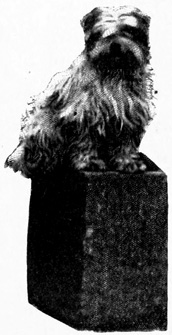
"But I cannot tell you how I wish to get away from all these temples. They begin to oppress me so,—all the people prostrating themselves, and then offering incense before each image in turn (and there are so many!), and lighting a candle before each. They arrive with great baskets full. And they come out of the temple with a rapt expression. And then our white long-haired terrier springs out on them, and they start so! We do not know what to do; because they call him a lion-dog (he is the Chinese idea of a lion), and seem to regard him as a semi-sacred thing. I do not want him to go into the temples at all. And the 366thresholds are so high he cannot get over; but there is always some one who will hand him over, and then the conceited dog shakes his sides and frisks about among the worshippers. This worship has been going on for thousands of years; and yet I do not believe any one has an idea about Puhsien!
「但是我無法告訴你我多麼想離開這些寺廟。它們開始讓我感到壓抑——所有的人在叩拜,然後依次在每個佛像前供香(這裡有很多佛像!),並在每個佛像前點燃一根蠟燭。他們帶著滿滿的籃子來。他們從寺廟出來時,神情專注。而這時我們那隻白色長毛的小獅狗突然跳出來,嚇了他們一跳!我們不知道該怎麼辦,因為他們叫它獅子狗(這是中國人心目中的獅子),似乎把它看作是半神聖的東西。我不想讓它進入寺廟。寺廟的門檻很高,它無法跨過去;但總有些人會把它抱過去,然後這隻自滿的狗就在拜祭者中間搖擺著身體跳來跳去。這種崇拜已經持續了幾千年;但我不相信有人真正了解普賢菩薩!」
"Then there is Kwanyin over and over again, like a Byzantine Virgin and Child, with a very sweet face on this mountain, and a child on her knee. And women come and pray for children, and carry away little dolls. The more I think of it, the less I know what I believe about it all. Nara, where they had worshipped for so many years in Japan, seemed to be haunted. But this mountain does not feel haunted, nor as yet does it feel sacred. But so far we are only up three thousand feet, with mosquitoes all alive about us, and scissor-grinders shrilling their souls out in just, I should think, the highest note possible for the human ear to hear, besides others more like other scissor-grinders.
「在這裡還有觀音,一遍又一遍地出現,就像拜占庭的聖母和聖嬰,她在這座山上面帶甜美的笑容,膝上抱著一個孩子。婦女們來這裡祈求孩子,並帶走小娃娃。越是思考這些,我越不知道自己對這一切的看法。在日本的奈良,人們多年來一直在那裡崇拜,似乎那裡被鬼魂纏繞。但這座山並沒有那種感覺,也還沒有感覺到神聖。然而,到目前為止,我們只上升了三千英尺,周圍還有活躍的蚊子,磨剪子的工人發出最高音調的叫聲,似乎是人耳能聽到的最高音調,還有其他類似的磨剪子工人的聲音。
"Then, though this temple seemed clean on first arrival by comparison with Chinese inns, its dirt now has a very materialising effect upon one's susceptibilities. It is beautifully situated on a spur of the mountain, with an amphitheatre of mountain-peaks girdling it in except on one side, where it looks down on the lesser hills and rivers we came up from. There are trees, and, we are assured, tigers, a man having been eaten by one ten days ago. But as I am also told eight men together were going up a peak not far from here, and of the eight five were 367killed by tigers, I am not quite sure whether one can believe everything one is told on Omi-shan. At all events, the tiger-mosquitoes seem a more real danger at present. We had sixteen nights in Chinese inns to get here from Chungking, travelling always westward; so I cannot think many Europeans will come, till there are steamers running to Chungking, and Cook has organised through-tickets. But the chief priest thinks if he could only do these rooms up many foreigners would come, and all give him many taels, and then the temples could all be restored."
「雖然這座寺廟初到時相較於中國的客棧顯得乾淨,但現在它的污垢對人的感官有非常具體的影響。寺廟坐落在山的一個山嘴上,周圍環繞著山峰,只有一側俯瞰我們上來的較小的山丘和河流。有樹木,也有老虎,據說十天前有個人被老虎吃了。但據說八個人一起爬一個離這裡不遠的山峰,其中五個人被老虎殺死,所以我不確定在峨眉山上所聽到的一切是否都可信。無論如何,虎蚊似乎是目前更實在的危險。我們從重慶到這裡花了十六個夜晚,住在中國的客棧裡,一路向西;所以我不認為在有蒸汽船開到重慶,或是康德旅行社提供直達票之前,會有很多歐洲人來這裡。但是住持認為,如果他能把這些房間修繕好,會有很多外國人來,每個人都會給他很多銀子,然後所有的寺廟都可以重建。」
JACK (LONG-HAIRED SHANTUNG TERRIER). By Mrs. Archibald Little.
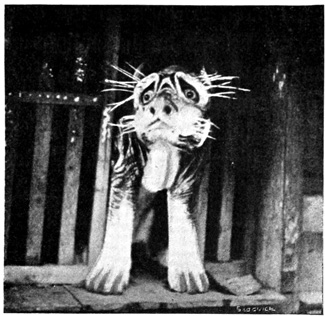
SACRED TIGER. By Mr. Upcraft.
There are many wonders upon this sacred mountain, one the so-called Glory of Buddha, which we saw every afternoon during the fortnight in August we spent on its summit. Another, more puzzling to me, we only saw once. We were called out about nine o'clock on a keen, frosty night to see the lamps of Kiating, the city ten thousand feet below us, that had come up to be lighted. Some rich donor has given the lamps of Kiating particularly high lamp-posts to facilitate this miracle. Certainly, on each out-jutting spur of the mountain, as 368we looked down from the edge of the great precipice, we saw a large luminous light apparently quite stationary, and in effect recalling the lamps of Piccadilly at night. Some people say this must be caused by electricity. Certainly, on Mount Omi we always seemed to look down upon the storms of thunder and lightning that evening after evening cooled the hot country below us. But the most beautiful sight was to turn away from the grand views as far as the eye could reach over the rivers and hills and cities of China, and, standing on the verge of the precipice, look just in the other direction, across the sea of mountains with serrated edges or slanting-backs, two flat-topped table-mountains conspicuous among them, till there at last up in the sky, "as if stood upon a table for us to look at," as some Chinaman said centuries ago, stood the long range of the snowy giants of Tibet, with great glaciers clinging to their sides, and catching the first rosy light of morning, whilst all the other intervening mountains were still wrapped in their blankets of mist and night.
在這座神聖的山上有許多奇觀,其中之一是所謂的「佛光」,我們在八月的兩周裡,每天下午都在山頂上看到它。另一個讓我更加困惑的現象,我們只見過一次。在一個寒冷霜凍的夜晚,約九點鐘,我們被叫出去看嘉定的燈光,那座城市在我們腳下萬英尺的地方,燈光照亮了整個城市。一位富有的捐贈者給嘉定的燈柱設置了特別高的燈杆,促成了這個奇跡。確實,當我們從峭壁邊緣往下看時,在山的每個突出點上,我們看到一個大而明亮的光點,似乎完全靜止,效果讓人想起皮卡迪利夜晚的燈光。有些人說這可能是由電力引起的。在峨眉山上,我們總是似乎俯視著下方熱帶地區的雷雨和閃電,但最美的景象是轉過身來,遠離那些壯麗的景觀,俯瞰中國的河流、山丘和城市,站在懸崖邊緣,向另一個方向看,越過鋸齒狀或斜坡狀的山脈,其中有兩座平頂山格外顯眼,直到最後在天空中,如同某位中國人幾個世紀前所說的「就像站在桌子上讓我們觀看」,看到西藏的雪山連綿不斷,巨大的冰川依附在山側,迎接清晨的第一縷玫瑰色光芒,而所有其他的山脈仍然籠罩在霧氣和夜晚的帷幕中。
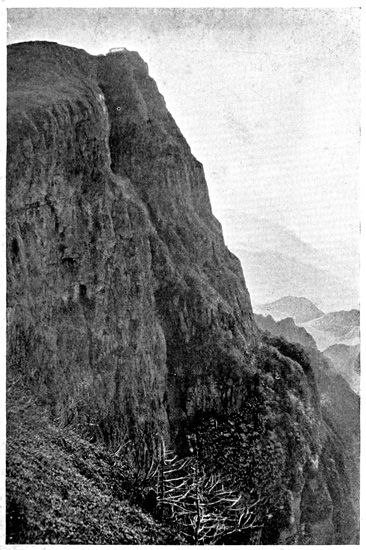
GREAT PRECIPICE OF MOUNT OMI. By Mrs. Archibald Little.