Church Mission's Action.—American Mission's Action.—T`ien Tsu Hui.—Chinese Ladies' Drawing-room Meeting.—Suifu Appeal.—Kang, the Modern Sage.—Duke Kung.—Appeal to the Chinese People
Church Mission's Action.—American Mission's Action.—T`ien Tsu Hui.—Chinese Ladies' Drawing-room Meeting.—Suifu Appeal.—Kang, the Modern Sage.—Duke Kung.—Appeal to the Chinese People.
To turn to a cheerfuller subject. Although the Roman Catholics, the American Episcopal Church, and some other missionary bodies have in former days thought it wiser to conform to Chinese custom in the matter of binding, there have been other missionary bodies, that have for twenty years or more refused to countenance it. One or two examples of their methods of work will probably suffice. The Church Mission at Hangchow opened a school for girls in 1867, and in 1896 Mr. J. L. Stuart wrote:
"The Mission undertook from the first to feed and clothe and care for the girls for about ten years; and it was required that the feet of the girls should be unbound, and that they should not be compelled to marry against their own consent. The school opened with three scholars; but the number soon increased to a dozen, and then to twenty, and after a few years to thirty, and then to forty, and for five years it has had fifty pupils. After the first few years, no solicitations were ever made for pupils, and they were not 146taken under eight or ten years of age; but there have always been more applicants than can be accommodated. For ten years the pupils have furnished their own clothing and bedding, and a few have paid for their food. The superintendent of the school took the ground in the beginning that, as the Mission undertook to support and train the girls, it was not only a right but it was an obligation to require the girls to conform to rules that were considered right and proper as far as possible. The success of the school proves the wisdom of the stand taken at the time. The girls have a good yard in which to play, and no sprig of grass 147can make headway where their big feet go romping about, and their rosy cheeks and happy faces are in marked contrast to the average Chinese girl seen in the street and in their homes. As the girls grow up and are ready to leave the school, in almost every case they have been claimed by some Christian young man who is not ashamed of their big feet. In the course of the past twenty-eight years many pupils have been sent out from this school; but, so far as is known, none of them have ever attempted to rebind their daughters' feet."
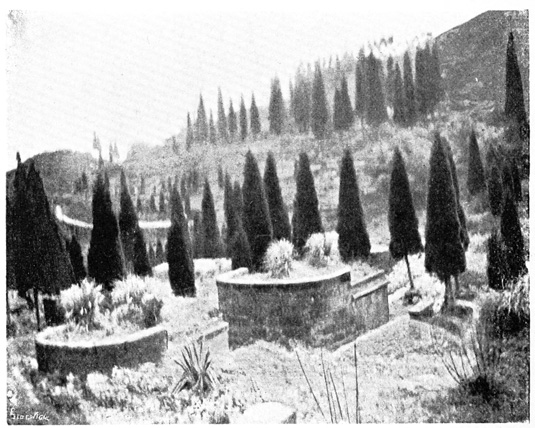
CHINESE ROMAN CATHOLIC BURIAL-GROUND.
By Mrs. Archibald Little.
A letter from Kalgan in the far north shows very quaintly the difficulties encountered by an American lady missionary, evidently an ardent anti-footbinder:
"Kalgan, China, September 24th.
"Anti-footbinding seems to be very much entangled with match-making on my part. I perhaps wrote about a little girl who came from four days' distance here to school, and unbound her feet, because I was to help the young man selected to be her husband, if he took a wife with large feet. The engagement papers were not made out, because the family wanted more betrothal money than I cared to give. I did not limit the young man at all. He could give what additional sum he pleased; but I would not give more than twenty-four tiao, about two pounds ten shillings; and thought that a good deal for a little girl of fourteen. The young man did not have any money, and rather wanted a small-footed wife; but his elder brothers exhorted him, and he gave in: but no additional money is to be expected from him. The little girl herself admires her young 148man very much, and said if her father did not give her to Yü Ch`ien (the young man) she would jump into the well when she got home. I have just heard that the father is dead. He was an opium-smoker, and wanted to betroth the girl where they could get the most money; but the brothers said, 'Let our sister be happy, even if the money is less.' His death may bring on the engagement, as they wish the money for the funeral expenses, I suppose. Did you ever hear of Chinese who had enough money on hand for funeral expenses?
"One of our schoolboys, whose mother engaged him to a little girl eight years old, told his mother he wanted his bride's feet unbound, so she could enter our girls' school here.
"I took the schoolgirls out for a pleasure-trip yesterday. They went to the beautiful new Russian church and churchyard, prettily laid out with trees, flower-beds, and a chime of bells in the bell-tower. Afterwards we went to a temple in the city. One of the priests said, 'Why don't your girls bind their feet?' I said, 'Why don't you bind your feet?' 'I! I'm a man!' I didn't talk further, as there was an unpleasant crowd gathering to watch the girls.
"Mr. McKee, of Ta-tung Fu, Shansi, is exercised over the future of his schoolgirls. His wife has now the charge of a school of six girls. No girls with bound feet can enter. Mr. McKee says no boy in Ta-tung will engage himself to a large-footed girl, even if his parents are willing; and if they are willing,149he or his big brother is not. I said, 'In Fenchou Fu, Shansi, there is a boys' school, and they can't get Christian girls enough for their brides.' But he said, 'No, Ta-tung has such a bad reputation for selling daughters, that no good family will let its daughters be married outside of the city or very near villages, for fear it will be said they have been sold.' The girls are young yet, and there is no immediate necessity for their marriage; so Mr. McKee trusts that Providence will provide bridegrooms when the time comes."
In April, 1895, I was happy enough to start the T`ien Tsu Hui, or Natural Feet Society. Up till then foreigners who were not missionaries had done but little, if anything, to prevent footbinding. It was, therefore, quite a joyful surprise to find that pretty well all the Shanghai ladies whom I asked were willing and eager to serve upon the committee. We began very timidly by republishing a poem written by a Chinese lady of Hangchow, sent down by Bishop Moule, and happily for us translated into English verse by Dr. Edkins, for one of our initial difficulties was that not one of us could read Chinese. We then ventured on another poem by another Chinese lady. After that we published a tract written in English by Pastor Kranz, sat upon and somewhat remodelled by the whole committee, then translated into Chinese for us by the Rev. Timothy Richard's Chinese writer. It is difficult for English people to understand what anguish of mind had been suffered by all the ladies on the committee, before we could decide into what 150sort of Chinese we would have our tract translated. There were so many alternatives before us. Should it be into the Shanghai dialect? and then, Should there be other translations into the dialects of the other parts? The women would then understand it. But, then, the women could not read. And were we appealing to the men or the women? And would not our tract be thought very low and vulgar in such common language? Should it be translated into ordinary mandarin? But would not the learned even then despise it? We knew of course—we all sat sadly weighted by the thought—that feet are the most risqué subject of conversation in China, and no subject more improper can be found there. And some of us felt as if we should blush before those impassive blue-gowned, long-tailed Boys, who stand behind our chairs and minister to our wants at tiffin and at dinner, when the latter knew that we—we, their mistresses—were responsible for a book upon footbinding, a book that any common man off the streets could read. In the end we took refuge in the dignified Wenli of the Chinese classics, confident that thus anti-footbinding would be brought with as great decorum as possible before the Chinese public, and that at least the literati must marvel at the beautiful style and learning of the foreign ladies, who, alas! could not read one character of the little booklet, whose type and red label we all examined so wistfully. We circulated our books as well as we could; we encouraged each other not to mind the burst of ridicule with which we were greeted 151by the twenty-years-in-China-and-not-know-a-word-of-the-language men. Our one French member was most comforting with her two quotations, "La moquerie provient souvent d'indigence d'esprit," and "La moquerie est l'esprit de ceux qui n'en ont point." But, to use the Chinese phrase, our hearts were very small indeed; for we knew the custom was so old, and the country so big. And what were we to fight against centuries and millions?
There was a drawing-room meeting held at Chungking, in the far west of Szechuan; and it was a most brilliant affair. The wealth of embroideries on the occasion was a thing to remember. One young lady could look neither to the right nor to the left, so bejewelled was she; indeed, altogether she was a masterpiece of art. But all the Chinese ladies laughed so gaily, and were so brilliant in their attire, that the few missionary ladies among them looked like sober moths caught in a flight of broidered butterflies. Every one came, and many brought friends; and all brought children, in their best clothes too, like the most beautiful dolls. At first, in the middle of the cakes and tea, the speeches seemed to bewilder the guests, who could not make out what they were meant to do, when their hostess actually stood up and addressed them through an interpreter. Then there was such eager desire to corroborate the statements: "On the north bank of the river near Nanking——" "Yes, yes!" exclaimed a lady from Nanking; "they don't bind there! And they are strong—very." Then, when the speaker went on to say that on the road to Chengtu there was a 152city where a large part of the population all intermarried, and did not bind their women's feet, being of Cantonese descent, Cantonese ladies nodded and smiled, and moved dainty little hands with impetuous movements, as if eager for interpreters in their turn to make themselves understood by the great, jolly Szechuan dames round them. And when the speaker further spoke of parts of Hunan where rich and poor alike did not bind, the two solitary representatives of Hupeh, the boastful, could bear it no more, but with quiet dignity rose, and said, in their soft Hupeh voices, "In Hupeh, too, there are parts where no woman binds—none." Next a missionary lady in fluent Chinese explained the circulation of the blood, and with an indiarubber pipe showed the effect of binding some part of it. There were no interruptions then. This seemed to the Chinese ladies practical, and it was quite striking to see how attentively they listened. This speech was afterwards a good deal commented on. A Chinese lady then related how she had been led to unbind, ceasing any longer to feel delight in the little feet that had once been such a pride to her. After which another English lady explained in the local dialect our one tract in the classic language, the rather difficult Wenli. The meeting was then thrown open, and at once the very smartest of the Chinese ladies present came forward to make a speech in her turn. All present were agreed that footbinding was of no use, but it could only be given up by degrees. Man man-ti (Little by little) was the watchword. Then, just 153as at an English meeting, a number of ladies went on to a dinner party. But the others stayed and talked. "Did you see my little girls listening?" said one mother. "They are thinking they will never have their feet bound again." And certainly the expression of the little girls had been eager in the extreme—poor little crippled creatures! with their faces all rouged to simulate the roses of healthy exercise.
But what did the men say? What they thought of the meeting we did not know; for as the husband of one of the ladies said next day rather crossly, "Oh, of course the women liked it! They don't want to bind their feet!" It seemed a step, however, to have got a Chinaman even to admit that.