Not a Mark of Rank.—Golden Lilies.—Hinds' Feet.—Bandages drawn tighter.—Breaking the Bones.—A Cleft in which to hide Half a Crown.—Mothers sleep with Sticks beside them.—How many die.—How many have all their Toes.—Feet drop off.—Pain till Death.—Typical Cases.—Eczema, Ulceration, Mortification.—General Health affected
Not a Mark of Rank.—Golden Lilies.—Hinds' Feet.—Bandages drawn tighter.—Breaking the Bones.—A Cleft in which to hide Half a Crown.—Mothers sleep with Sticks beside them.—How many die.—How many have all their Toes.—Feet drop off.—Pain till Death.—Typical Cases.—Eczema, Ulceration, Mortification.—General Health affected.
並非身份的象徵——金蓮——鹿蹄——緊裹的繃帶——折斷骨頭——可藏半克朗的裂縫——母親床邊放著棍子睡覺——有多少人因此死亡——有多少人所有腳趾都完好——腳趾脫落——痛苦至死——典型案例——濕疹、潰瘍、壞疽——全身健康受影響。
It is a popular error in England to suppose that binding the feet is a mark of rank in China. In the west of China women sit by the roadside begging with their feet bound. In the far north, where women do field-labour, they do it, poor things! kneeling on the heavy clay soil, because they cannot stand upon their poor mutilated feet. Another popular error in England is that the custom was introduced in order to prevent women from gadding about. Never in all the many conversations I have had with Chinese upon this subject have I heard this reason alleged or even hinted at, nor is it ever alluded to in any of the Chinese literature upon the subject. The popular idea in China is that Pan-fei, a favourite of the Emperor Ho-ti, of the Chi Dynasty, whose capital was Nanking, was so 135beautiful that golden lilies sprang out of the ground wherever she stepped; hence the name of "golden lilies" for the hideous goatlike feet Chinamen so strangely admire. Ho-ti is said to have so loved Pan-fei as to have had golden lotus flowers strewn on her path for her to walk on. But there is another tradition that Tan-ki, the wife of the last Emperor of the Shang Dynasty, who in despair burned himself 136in his palace with all his treasures in 1120 B.C.—that Tan-ki was the introducer of these strange feet. She seems to have been a semi-mythical character—a changeling, with "hinds' feet" covered with hair. So she wound bandages round them, and wore lovely little fairy shoes, and every one else tried to follow suit. But to come to later and somewhat more historic times, a King of the Sung Dynasty, A.D. 970, had a favourite wife Niao-niang, whom he used to like to see posing or dancing upon golden lotus flowers. And to make her feet look more lovely she used to tie strips of coloured satin round them, till they resembled a crescent moon or a bent bow; and thus the fashion began, some say.
在英國,人們普遍誤以為裹足是中國的一種身份象徵。在中國西部,婦女坐在路邊乞討時也會裹足。在中國北方,婦女從事田間勞動時,因為無法站立,只能跪在厚重的黏土上,這些可憐的人無法站立在她們變形的腳上。另一個在英國常見的誤解是,裹足的習俗是為了防止婦女四處走動。在我與中國人就這一話題進行的眾多談話中,從未聽過這種理由,也從未在有關這個主題的中國文學作品中提到過。
中國流行的說法是,齊朝(Chi Dynasty)首都為南京的皇帝何帝(Ho-ti)的寵妃潘妃(P`an-fei)每次行走時地上都會長出金蓮花,因此中國人稱這種奇怪的羊蹄般的腳為“金蓮”,而中國人奇特地欣賞這種腳。據說何帝如此愛潘妃,以至於在她的路上鋪滿了金色蓮花。
但還有另一種傳說,認為是商朝最後一位皇帝的妻子妲己(T`an-ki)引入了這種奇怪的腳。妲己在絕望中於公元前1120年與他的所有財寶一起在宮殿中自焚。據說她是一個半神話人物,擁有“鹿蹄”,並覆蓋著毛髮。於是她用繃帶裹住雙腳,穿上美麗的小仙鞋,其他人都試圖效仿她。
但如果回到較近且更具歷史意義的時期,公元970年宋朝的一位國王有一位寵妃鳥娘(Niao-niang),他喜歡看她在金蓮花上擺姿勢或跳舞。為了讓她的腳看起來更美麗,她用彩色緞帶繞著腳,直到它們變得像新月或彎弓一樣。據說這就是這一時尚的起源。
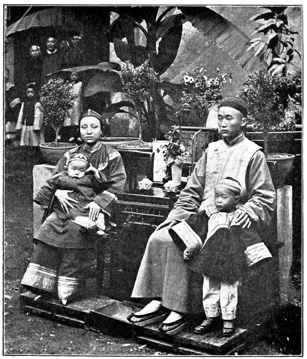
CHINESE ROMAN CATHOLICS OF MANY GENERATIONS. By Mrs. Archibald Little.
中國歷代天主教徒。 作者:阿奇博爾德·李特爾夫人(Mrs. Archibald Little)
It is obvious, however, that a nation that has not stockings naturally takes to bandaging its feet, and that so doing, quite without intending it, it is very easy to alter the shape of the feet by binding them ever a little tighter, as many a European lady has done with her waist. Chinese civilisation being very ancient and conservative, abuses there go on increasing, and become exceptionally exaggerated. The Chinese are also as a nation curiously callous to suffering either in themselves or others, not taking pleasure in the infliction of it, as is the case with some more highly strung natures, but strangely indifferent to it. In all probability at first women simply bandaged their feet somewhat tightly. And just as a man in Europe used a little while ago to attach especial importance to a woman's being well shod and to the turn of her ankle, so did a Chinese man, till in the course of a thousand years we have arrived at the 137present abortions with a two-and-a-half-inch measurement, as also at all these stories of long dead and gone empresses and lotus flowers.
然而,很明顯,一個沒有襪子的民族自然會採用裹腳的方式,而這樣做,很容易在不經意間通過將腳裹得更緊來改變其形狀,就像許多歐洲女士對腰部所做的那樣。由於中國文明古老且保守,這些弊端逐漸增多,並變得異常誇張。作為一個民族,中國人對自己或他人的痛苦奇怪地冷漠,不像某些情感更激烈的民族那樣以折磨他人為樂,而是對痛苦冷漠無情。很可能最初婦女只是稍微緊裹雙腳。而正如以前在歐洲,一個男人會特別重視一個女人穿鞋是否得體以及她腳踝的形狀,中國男人也是如此。經過千年的發展,我們現在有了這些腳長僅兩寸半的畸形足,以及關於已故皇后和蓮花的傳說。
The method of binding and the period of beginning naturally differ somewhat over the whole extent of this vast empire. In the west binding seems generally to begin at six years old. In the east it is generally from five to seven, or at the latest at eight, years of age. Tsai, the good-natured Governor of Shanghai, when I met him there at a dinner party at our Chief Justice's, looked across the table at me, and said in his somewhat humorous, jerky voice, "I know what you want to talk to me about. You want to talk to me about footbinding. It is very hard, is it not? The poor little things have but two years to run." So that it would seem as if in his part of the country or in his own family binding began earlier. In the east of China the bandage is said to be of strong white cotton-cloth, two yards long and about three inches wide; and I have generally seen a two yards long bandage. The cloth is drawn as tightly as the child can bear, leaving the great toe free, but binding all the other toes under the sole of the foot, so as to reduce the width as much as possible, and eventually to make the toes of the left foot peep out at the right side and the toes of the right foot at the left side of the foot, in both cases coming from underneath the sole. Each succeeding day the bandage is tightened both morning and night; and if the bones are refractory, and spring back into their places on the removal of the bandage, sometimes a blow is given with 138the heavy wooden mallet used in beating clothes; and possibly it is, on the whole, kinder thus to hasten operations. Directly after binding, the little girl is made to walk up and down on her poor aching feet, for fear mortification should at once set in. But all this is only during the first year. It is the next two years that are the terrible time for the little girls of China; for then the foot is no longer being narrowed, but shortened, by so winding the bandages as to draw the fleshy part of the foot and the heel close together, till it is possible to hide a half-crown piece between them. It is, indeed, not till this can be done that a foot is 139considered bound. During these three years the girlhood of China presents a most melancholy spectacle. Instead of a hop, skip, and a jump, with rosy cheeks like the little girls of England, the poor little things are leaning heavily on a stick somewhat taller than themselves, or carried on a man's back, or sitting sadly crying. They have great black lines under their eyes, and a special curious paleness that I have never seen except in connection with footbinding. Their mothers mostly sleep with a big stick by the bedside, with which 140to get up and beat the little girl should she disturb the household by her wails; but not uncommonly she is put to sleep in an outhouse. The only relief she gets is either from opium, or from hanging her feet over the edge of her wooden bedstead, so as to stop the circulation.
裹足的方法和開始的年齡在這個廣大帝國的不同地區自然會有所不同。在西部地區,裹足通常從六歲開始。在東部地區,一般從五到七歲開始,最遲在八歲。當我在我們的首席法官的晚宴上遇到善良的上海總督蔡先生時,他看著桌對面的我,用他那略帶幽默和急促的聲音說:“我知道你想和我談什麼。你想和我談裹足。這很難受,是不是?可憐的小家伙們只有兩年時間可以跑跳。”由此看來,在他所在的地區或他的家族中,裹足開始得更早。