Taels.—Dollars.—Exchange.—Silver Shoes.—Foreign Mints
How Chinese look upon Shanghai.—A Viceroy's Expedient.—Method of raising Subscriptions.—Deserving Deities.—Trustworthiness.—Hunan-Hero.—Marrying English Girls.
Missionaries generally say that the Chinese are frightfully immoral. So do the Americans and Australians, excluding them as far as they can from their respective countries. But, brought up on the English saying that "Hypocrisy is the compliment vice pays to virtue," I always think virtue must be in the ascendant in China for vice so to slink into corners and hide its head before it. There certainly is not the slightest outward appearance of vice in Chinese cities. And I have always understood that everywhere, except in the foreign settlements, where it is certainly not the case, very decided repressive measures are used. Shanghai, once the Model Settlement, is looked upon as a hotbed of corruption by Chinese fathers up-country, who say gravely they would not dare to send their sons there, whatever business advantages are offered, until their principles are quite firmly established. Up-country it is European morals 198that Chinese find as shocking as Australians find theirs. It is impossible for me to enter into details here; but there are certain things, alas! too customary among Europeans, which to every Chinaman are an abomination. It is well to bear this in mind, perhaps; and it is to be hoped that increased intercourse may lead Europeans to think disgraceful what Chinese already think so, and Chinese to be bound by the European code where, if anywhere, it is higher than their own, rather than, as so often occurs, to lead each nation to accept the other's lower ideas.
As new suggestions however, are always more interesting than trite generalisms, I must mention the peculiar measure devised in 1891 by his Excellency the Viceroy at Nanking to keep up the standard of morality among his writers and the higher class of employés. Shortly before, one of the composers of memorials had taken to leading a fast life, frequenting places not over-respectable. One day he leaned out of a wine-shop, and saw two men, dressed in black, standing quietly by his horse. He took no notice of the matter, but kept on drinking. When he left the place and walked up to his horse, the two strangers retired a pace or two. Climbing into the saddle, he rode slowly along, cooling himself in the evening breeze. He soon heard footsteps, and perceived the men were following him. His heated brain imagined fearful consequences. The mysterious personages might be bandits or secret society men bent on assassination or plunder. He whipped up his horse, and made for his official quarters 199in the residence; but his pursuers were fleet of foot, and kept up with his not very fast pony. On reaching the Viceregal residence, the writer called upon the guards to arrest the two bold men, who came up breathless. But the guards did not move to obey his orders, and the mysterious beings stepped up, saluted, and said, "Sir, do not feel angry or apprehensive. We are members of the Secret Police of his Excellency the Viceroy. We have received instructions, to follow any and all the officials and gentlemen connected with the office, and report to our master where they go, their actions, behaviour, and conduct." Then they turned, mingled with the crowd, and disappeared. Next day the writer's pony was reported to be for sale, and since that memorable evening he has not revisited his former haunts. Possibly this method might be adopted with advantage by any high official in England, who was as solicitous about the conduct of his subordinates as this Chinese Viceroy.
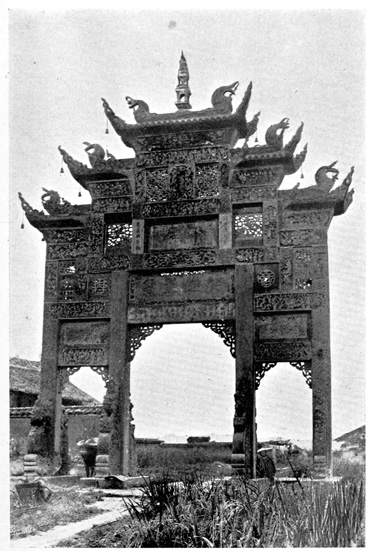
Probably no one knows better than Li Hung-chang how to get hold of other people's money. Here is an idea of his for collecting contributions to a Famine Relief Fund. He furnishes a long list of subscriptions, mostly of £150 each, from officials whose generosity was due to the promptings of their parents or other relatives now deceased. Each donor had been granted permission to erect an archway (pai fang) to the memory of the person, who first inspired him with the idea of contributing to the relief of suffering humanity. Among those to whom this honour was accorded were 200the President and members of the Chinese club at Yokohama, whose joint contributions amounted to £300.
The west of China is exceptionally decorated with these memorial arches, generally erected to the memory of chaste widows and incorruptible officials, who, to judge by the arches, seem more numerous than one would otherwise have thought. I remember the interest with which we approached one in course of construction. It was a very hot day, and this pai fang was being erected on a slight eminence, where the people told us no rain had fallen for forty years, although thunder-showers refreshed the country all round it. We ate our luncheon under its shadow, and observed that it was one of Li Hung-chang's arches, erected to the memory of a dead man, the inspirer to an act of charity towards the famine-stricken. The Chinese are a people altogether guided and animated by memories. In the same year the Governor of Honan submitted a petition from the gentry and inhabitants of the town of Wensiang, in which they prayed for permission to erect a memorial temple to the late intendant of their circuit. This town, it seems, borders upon the Yellow River, from the ravages of which it had suffered terribly for a long succession of years. Two years before a movement was started by the local magistrate and the people for building a breakwater to serve as a barrier against the floods. "The Taotai, in whose jurisdiction the place was situated, took an active interest in the enterprise, and even went frequently in person to superintend the progress of the 203work. The great difficulty experienced was the want of sufficiently large stones. Greatly to the astonishment of the whole community, a heavy storm of wind and rain deluged the country, and brought down an endless quantity of huge stones exactly suited to the purpose. The people naturally regarded the strange occurrence as a direct manifestation of divine power in aid of a great public undertaking, which they and their forefathers had been unable to complete during several centuries. The Taotai fell a victim to fatigue and over-exertion, and his death was deeply bewailed by the whole district. The Governor, in supporting the petition, mentioned a fact which proves the supernatural origin of the phenomenon. One of the stones, which was as large as a house, and shaped like a tortoise, was inscribed with seal characters, only two of which, denoting 'work' and 'stone' respectively, could be made out. The breakwater was completed, and the safety of the district secured. As a token of their gratitude for the services of the Taotai, the petitioners begged that they might be permitted to erect a temple to his memory, at which the usual sacrifices should be offered.—Granted by Rescript."
MEMORIAL ARCH.
By Mrs. Archibald Little.
But it is not only public benefactors and deserving officials who are rewarded by memorials. Deserving deities or patron saints also meet with recognition. Thus in 1891 an application was made to the Throne for two Imperial tablets, bearing his Majesty's sign-manual, to be suspended in the temples of the dragon-king and the god of fire at Chiwan-chow. The 204latter district, consisting of six villages, which contribute to the Exchequer some 10,000 taels, had no proper water system, and was entirely dependent for its supply of that precious commodity on the periodical rains. Of late years, whenever rain had not fallen in due season, prayers offered up at these two shrines had ever been graciously answered. Moreover, in the seventh moon of the previous year, just when the crops were ready for harvesting, a heavy fall of rain came on, and threatened to submerge the fields. But a visit on the part of the gentry and people of the neighbourhood to the temple of the god of fire had the effect of dissipating the clouds and causing the rain to cease, so that the grain could be gathered in in due season. Two months later, when about to sow the second crop, a thorough soaking rain was necessary to prepare the ground for the seed; but for days no rain fell, and the people greatly feared that they would be unable to sow. A visit to the temple of the dragon-king, however, had the desired effect, and dispelled all gloomy prospects of a dearth of food.
It was in recognition of these gracious favours of the gods that the memorialist ventured to prefer this request, which was accordingly granted. Many people may laugh at this. It seems to me rather an act of faith of which we might find many parallels in Europe in the Middle Ages, and of which individually I should be glad to find further examples now. "Whom we ignorantly worship" will be a true description of man's part as long as he lives upon this earth with 205darkened eyes. But it is only when he ceases to worship that there seems to be little hope for him. There is little enough of worship in China as it is, and what there is naturally seems to us of Europe somewhat superstitious; for the religions of China appear to have had their day, to have effected what they could for China, and to be passing away. Is it true that the youthful Emperor Kwang-shü was considering with his adviser Kang whether Christianity should not be adopted as the national religion, when he was precipitated from the throne by the woman who rules China single-mindedly for her own advantage?
That crime is not very rife in China is sufficiently shown by their having no police force. Foreigners are sometimes shocked by the severity of Chinese punishments, not realising that it is our excellent police that enable us to mitigate our scale of punishments. But the Chinese are like women in this respect also. They afford an extraordinarily small percentage of criminals to the world's criminal roll, and of these the most part are for petty theft. In business dealings, unlike the Japanese, the Chinese keep to their word, even when it is to their own disadvantage to do so. And merely saying, "Puttee book," without any signed and sealed written entry, held good as a legal transaction all through China, till, alas! an old-established English firm, probably already foreboding the failure that afterwards overwhelmed it, repudiated a transaction of which there was no further record than the till then two sacred words. Since then Chinese, like other nations, 206have recourse to written documents; but so high always is the sense of business obligation among them, that each China New Year many men, unable to discharge their obligations, commit suicide rather than live disgraced. This is the more remarkable among a nation that adulterates everything it knows how to, resorts to every business subterfuge, thinks not to lie foolish, and to be found out only stupid, not disgraceful. When, however, we denounce Orientals for want of truth, do we realise how untruthful we are ourselves, and that what shocks us is rather the different kind of falsity from that to which we are accustomed? I have yet to find the English bootmaker or worker in fur, who can be relied upon to keep to his word as to 207the day on which he has promised anything; whilst I have met with more than one Chinese tailor, who may be relied upon to appear with his work finished to the very day and hour, his given word being sacred to him. The English tradesman thinks it wrong to lie about the past, the Chinese about the future.
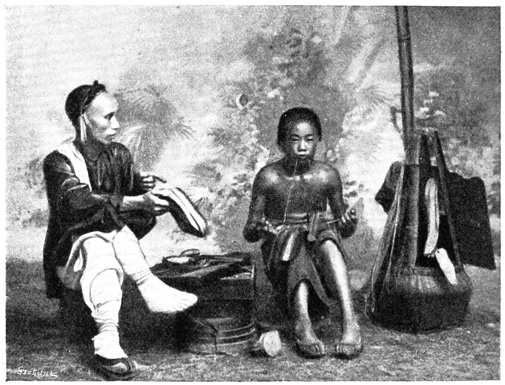
SHOES TO MEND.
One of the most remarkable things about Chinese is that, whilst of course it is usual for people of other nationalities to denounce their bad qualities as a nation, there is hardly a European living in China who has not one or more Chinese whom he would trust with everything, whom he would rely upon in sickness or in danger, and whom he really—if he spoke out, as we so seldom do—regards as the embodiment of all the virtues in a way in which he regards no European of his acquaintance. We rarely believe in one another's Chinaman; but we are each of us absolutely convinced of the fidelity, trustworthiness, and shrewdness of our own particular Chinaman. Whilst among missionaries life in China is generally sweetened by the recollection of some one Chinaman, at least, whose sincerity and holiness of life shine out to them as a bright example and beautiful memory.
The merchants look askance at the missionaries' saints, and missionaries are very suspicious of the merchants' business employés and butlers. But a nation, that all through the land produces men, who so thoroughly satisfy their employers, cannot be called a decadent race; nor, indeed, are any of the signs of decadence with which I am acquainted to be discovered 208among the great Chinese people, who appear always hard-working, good-humoured, kindly, thrifty, law-abiding, contented, and in the performance of all duties laid upon them astonishingly conscientious. I have never known a servant shirk any task imposed upon him, because he was tired or ill, or because it was late at night. Let unexpected guests arrive, the Chinese servant always rises to the occasion, and the honour of the family is safe in his hands. "Oh, but we have always heard Chinese were good servants," some one remarks. Let me relate a story of another kind of virtue!