Missing Bride.—Wedding Reception.—Proxy Marriage.—Servants' Weddings.—Love for Wives.—Killing a Husband.—Wifely Affection.—Chinese Babies.—Securing a Funeral
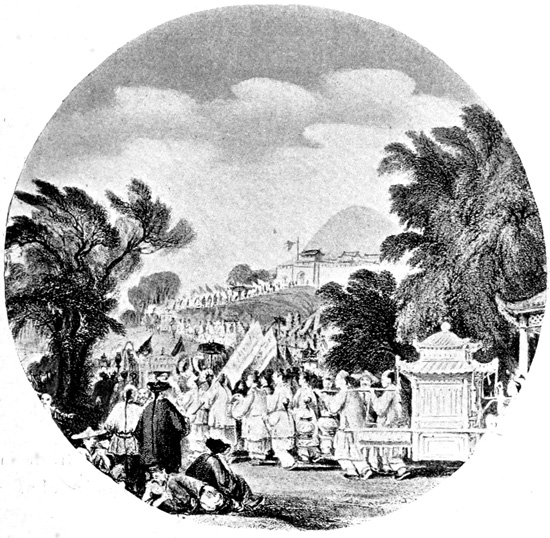
In China a bride usually rides in a richly embroidered red sedan-chair, decorated with flowers, and hired for the occasion. Not long ago in Canton city a man hired a chair to carry his bride to his homestead in the suburbs. The distance was great, and the hour late. When the four chair-coolies and the lantern-bearers arrived at their destination, the chair containing the bride was deposited outside the doorway to wait the auspicious hour selected for opening the door to admit the bride, and the coolies adjourned to an opium-den; and as they had travelled a long way and were tired, they soon fell asleep. How long they dozed they knew not; but on awakening, they returned, and found the bridal chair outside the doorway. They came to the not unnatural conclusion that the bride had already entered the household, and that the chair was left there for them to take back to the city. Since they had all received their pay in advance, they did not stop to make further inquiries, but hurried home with the 185chair, put it in a loft, and, rolling themselves up in their beds, slept the sleep of the just. In the meantime the bridegroom heard the bridal party arrive, but had to wait the stroke of the auspicious hour before welcoming the bride. At last the candles were lit, incense-sticks were lighted, the new rice and viands for entertaining the bride were served, the parents-in-law put on their best suits, and so did the bridegroom, and with much pomp and ceremony the door was thrown 186wide open; but as far as the lantern's light would reach, lo! there was not a trace of the bridal chair, or bride, nor a single soul to be seen. Great was their consternation, and it became greater still as they concluded that bandits must have kidnapped the bride, and would hold her for ransom. The district officer was aroused, the case was reported to the village justice of the peace, and search parties were sent out in every direction. The bridegroom, though distracted, had sense enough to rush to the city and make inquiries of the chair-bearers. The coolies were dumbfounded, and explained what they had done. Together they climbed to the loft, opened the door of the chair, and found the demure-looking bride, long imprisoned and half-starved, but still appearing to her best advantage in her beautiful bridal gown. The bride appeared to have known that she was being carried backwards and forwards; but could not protest, because it is the custom for brides not to open their lips till the marriage ceremony is performed. Hence all the trouble.
WEDDING PROCESSION.
Lent by Scotch Presbyterian Mission.
This little story, taken almost verbatim from a Chinese newspaper, shows how far a bride's silence is carried. During all the days of reception after the wedding she is supposed to stand up to receive each incoming guest, who may make what remarks he pleases, even of the most personal nature, but never a word may she say; whilst attendant maids pull back her skirts to show how small her feet are, etc.
At one wedding I saw the poor bride grow so painfully crimson under the comments of a very young man, 187that I took for granted he must be some rude younger brother, and without thinking said so, and found I had done quite the right thing; for the youth—who was no relation at all—incontinently fled, feeling he had over-stepped the bounds of propriety. Besides not speaking, the bride is supposed not to eat. At the only wedding-feast I have attended—I have been to several receptions—the unfortunate bride and bridegroom had to kneel and touch the ground with their foreheads so often, that even if well nourished one wondered how they could live through it. The bride had to serve all the ladies with wine, the bridegroom to go round the men's tables and do likewise. When the size of the bride's feet is further considered, and the weight of the jewellery in her hair, one wonders a little in what frame of mind the poor bride ultimately approaches her groom. It must certainly be in an absolutely exhausted condition of body.
An amusing matrimonial incident may be worth repeating here. A young fellow was to be married on a certain lucky date; but his business having taken him away just before the event, he found it impossible to get back in time. He wrote to his parents, begging them to get the ceremony postponed. To this suggestion many objections were raised by relatives and friends and invited guests, and a strong despatch was forthwith prepared, peremptorily commanding his attendance on the original date. Again the bridegroom pleaded business, and said that he really could not come, whereupon the incensed father straightway took 188his departure for regions unknown, leaving the mother to do as she liked in the matter. The latter was a woman of original ideas, and, finding herself thus left alone, resolved, for the honour of the family, to resort to strategy. Giving out that the bridegroom had actually returned, but would not be visible until the day of the marriage, she cleverly dressed in male attire a buxom daughter, who is said to have been at all times very like her brother, and made her act the part of happy man throughout the ceremonial. When the latter was finished and the deception was disclosed or discovered, the hymeneal party is said to have broken up in fits of laughter, and in praise of the mother whose genius had evolved so satisfactory a method of overcoming a serious domestic difficulty. The proxy marriage will, it is said, hold good, and, nolens volens, the son is now regarded by his family and friends as a married man.
When one of our many cooks once wanted a wife, he discussed the matter in very businesslike style with my husband. "I can get a wife in Szechuan for ten dollars," he said. "But, then, I can know nothing about her family and habits, as I could if I took a wife from Hupeh"—his own province. "It is true there I should have to pay more. But here all the women drink wine and smoke, and many of them smoke opium. And you never can know the truth beforehand. Now, if I find after marriage that the woman I have chosen smokes opium, there will be my ten dollars gone, and nothing to show for them. I shall wait 189till I can go home to my own province. Aren't you going that way soon, master? Promise you will take me when you do." However, after all these wise sayings, he was over-persuaded by the account he heard of some woman, married her, and was, I think, very fortunate in her, but that the poor creature died of some painful internal disease two years afterwards.
Our water-coolie made such a fuss over his wedding, gave such a feast, invited so many guests, and borrowed so much money to defray expenses, that I do not see how it is possible in all the course of his life for him to get out of debt again; for though he had made an elaborate calculation that each wedding guest would give a present worth more than his share of the feast would cost, and that he himself would thus really make money by it, he found himself disappointed. It is curious as, perhaps, indicating the mortality among the women of China that all our servants, with the exception of one who has left our service, have lost their wives at least once during the twelve years I have been in China; and not one of the wives can have been over forty.
The men seemed proud of their wives, and good to them according to their ideas; but it certainly was extraordinary how little they seemed to feel their loss when they died. Yet I suppose they care sometimes. Whenever we visit in Chinese houses, my husband generally tries to rejoin me when he can, knowing that my knowledge of Chinese cannot carry me very far, and that consequently my intercourse with the ladies of the 190house is apt to become rather fatiguing to both parties after a time. On one occasion I was surprised to see him come in so very soon, and with two young men. One of the young fellows said to me in a good-humoured way, "We want him to enjoy himself, and we notice he is never so happy as when he is with you. Oh, yes! we have husbands like that too." One of the governors of Chungking was said, indeed, to be so fond of his wife as to order naval reviews on the river for her amusement. He built a specially pretty pavilion in the highest part of the city for her to have dinner parties there, and possibly it may have been partly grief over her loss—she died of the fright caused by a very great fire that all but burnt their official residence—that made him afterwards go out of his mind for a time. Another Chinese official, ordered to take up high office in Tibet, was so determined his wife should accompany him, that, as the Tibetans will not allow Chinese women to pass a barrier a few miles beyond Tachienlu for fear of the Chinese settling down and overrunning the country, he had her dressed as a man and carried in a sedan-chair, which she never got out of. So it seems some Chinese husbands value their wives beyond the price they pay for them. But with our servants that last seemed to be all they thought of. And yet I still hear the soft caressing tones in which our head servant's wife used always to address him. She was a very plain woman, but so quiet, and made so little demands for herself, wanting always apparently only to be serviceable, that as her husband 191rose in social position and wealth it always touched me to see the way in which this honest, homely creature would look round on the fine ladies she was brought in contact with, and who at first tried to put her down, but were always in the end won over by her perfectly unassuming manners.
Another woman's husband was a man of violent temper, who insisted upon her working very hard; and the result was continual bickering between the couple, which frequently led to the interchange of blows and bad language. The wife appealed on several occasions to her mother's people for protection; but after trying to comfort her, they always sent her back to her husband. About a month after the marriage the husband ordered his wife one day to go and cut firewood on the hills; but not having been accustomed to carry burdens, she declined to go, and received in consequence a severe beating. A little later she was again beaten and abused by her husband for not washing his clothes clean enough. About the same time she made use of a sum of 400 cash (not quite a shilling) belonging to her husband; and when he discovered the fact, he gave her a sound thrashing with a stick, and vowed that he would repeat the treatment on the following day if she did not produce the money. A month passed, during which continued squabbling occurred between the man and his wife, the latter having frequently to go without food, and being threatened with a divorce for her bad behaviour. At last the woman, exasperated by the treatment she was receiving and dreading the disgrace 192of a divorce, determined to make away with her husband. A year before, while still unmarried, she had accompanied an old woman in the village on a herb-gathering expedition on the hills, and remembered her companion pointing out to her a poisonous plant, which, if eaten, cut asunder the intestines and caused sudden death. Having gone on several occasions to gather firewood, she kept careful watch for this particular plant, and succeeded in collecting a handful, which she hid away until she could find a favourable moment for making use of it. At last she found her opportunity one day when her father-in-law, her husband's brothers, and her sister-in-law all happened to be from home, and only she and her husband were left in charge of the house. Shortly after noon she began to prepare the evening meal, and poured over the vegetables the infusion obtained by boiling the poisonous plant. She handed his supper to her husband, left their portion for the remainder of the family, and then went out on the excuse of having to make some purchases. The father and his three sons returned shortly afterwards; and being hungry after their day's work, they all partook heartily of the poisoned food. Symptoms of poisoning very soon followed, and the whole family was found by a neighbour lying on the floor in a state of great agony. Two of them were saved by means of emetics; but the father, the woman's husband, and a brother of the latter all died the same night. The woman was found, and handed over to the authorities, who, after a protracted trial, in which she declared her innocence, found her 193guilty of the murder. She was condemned to death by the lingering process on two different counts, and would, as the law provides, receive some additional slashes of the knife at the time of the execution. All the poisonous herbs in the district were ordered to be removed, so as to prevent the repetition of such a crime in future. When a parricide occurred in ancient times, the authorities used to order that the whole city, where such a hideous crime had been committed, should be razed to the ground; and on the Yangtse the traveller sees the ancient site of the city of Chungchow on an island without now a house upon it, because of such a 194crime, the city having by order been moved to the river-bank, where it now stands among its groves of waving bamboos.
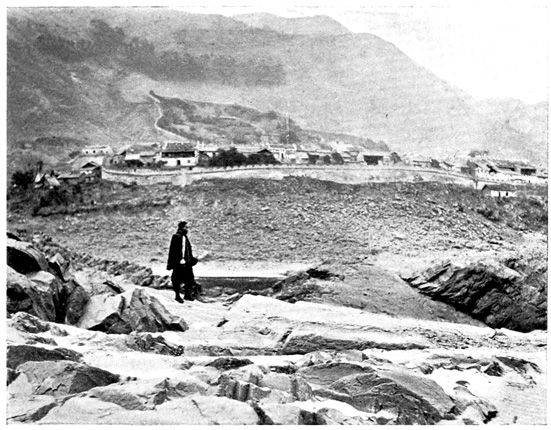
NEW KWEICHOW, BUILT BY ORDER.
By Mrs. Archibald Little.
The following story tells again of wifely affection, and incidentally throws a little light upon Chinese clairvoyance, a subject which seems to attract more attention in England than in China now.
A Nanking lady was sad, very sad. Her husband had left her for business far away, and had sent home only a few letters. Many times did she send word by his friends requesting him to return, but he did not come. At last, in despair, she called in a fortune-teller, who was supposed to be endowed with supernatural knowledge of everything past, present, and future. After consulting his books, the fortune-teller's face assumed a thoughtful and anxious expression. In trembling accents he addressed the sad wife thus: "O lady, your husband has changed his sphere of business many, many times. Ill-luck has pursued him everywhere. Money he has now none; but, what is worse, he is lying dangerously ill in a lonely inn, hundreds of miles from here." The wretched lady was heartbroken, and began to weep copiously. The fortune-teller comforted her, and rapidly turning over the leaves of his mystic book, he joyously exclaimed, "Saved!" Then he explained that a certain lucky star was obscured by a dark cloud; and that if it could be made to shine again, her husband would rise from his bed of sickness, and make a great deal of money. About two shillings was the sum charged for working the miracle 195of dispelling the dark cloud. While the fortune-teller was on his knees, earnestly praying his god to deliver the absent husband from the clutches of the evil one, who was obscuring the lucky star, the door was abruptly pushed open, and there, standing on the threshold with a bag over his shoulder, full of shoes of silver and gold bars, was the long-absent husband. The wife gave a cry of joy and rushed forward. The confused fortune-teller, terribly frightened, hurriedly sought an exit by the back door, but slipped, fell, sprained his ankle, and broke his head. The husband did not wish to mar the joy of his return by any harsh measures, and let off the now thoroughly wretched fortune-teller with a reprimand.