Everybody Guaranteed by Somebody Else.—Buying back Office.—Family Responsibilities.—Guilds.—All Employés Partners.—Antiquity of Chinese Reforms.—To each Province so many Posts.—Laotze's Protest against Unnecessary Laws.—Experiment in Socialism.—College of Censors.—Tribunal of History.—Ideal in Theory.
Possibly that state of society in which the individual is the unit is a more advanced form of civilisation; but it is impossible to understand China unless it be first realised that the individual life is nothing there, and that the family is the unit; and yet further, that no one stands alone in China, as is so painfully the case in England, but that every one is responsible for some one else, guaranteed by some one else. And here, to those who wish to read a really exact, circumstantial account of the Chinese and their ways, let me recommend John Chinaman, by the Rev. George Cockburn, quite the best book I have read on the subject, and one that deserves a wider circulation than it has attained, being written in terse, epigrammatic English, with a flavour of Tacitus about 533it. Alas! the writer is no more,—a silent, reserved, black-browed Scotchman, with a fervour of missionary zeal glowing under a most impassive exterior. The riot, in which all our own worldly goods in China were destroyed, wrecked for ever the nervous system of his strong, handsome, brave young wife. And what with that and the details of daily life, all laid upon the shoulders of a man by nature a student and a visionary, he left China, and soon after passed away beyond the veil, where, if we share the Chinese belief, let us trust his spirit is gladdened by words of appreciation of the one little volume in which he embodied the fruits of years of work and thought in China, dying, as far as I remember, almost as it appeared. The wreckage of missionary lives and hopes is one of the tragedies of European life in China, and one which a little more understanding and sympathy on the part of missionary boards at home might often, it would seem, avert.
可能那種以個體為單位的社會形態是一種更為先進的文明形式;但若不先認識到在中國個人生命毫無意義,而家庭才是單位,就無法理解中國;再者,在中國沒有人是孤立的,這在英格蘭是如此痛苦的情況,但在中國,每個人都對其他人負有責任,由他人擔保。此處,對於那些希望閱讀一部真正精確、具體描述中國人及其生活方式的書籍的人,我推薦《約翰·中國人》(John Chinaman),作者為喬治·科克本牧師(Rev. George Cockburn),這是我讀過的最好的一本書,值得比目前更廣泛的傳播,書中以簡潔、格言式的英語書寫,帶有塔西佗(Tacitus)的風格。可惜,作者已不在人世,他是一位沉默、內斂的黑眉蘇格蘭人,外表極為冷漠,但內心燃燒著傳教的熱情。那場暴動摧毀了我們在中國的所有世俗財物,永遠摧毀了他那強壯、俊美、勇敢的年輕妻子的神經系統。由於這些加上日常生活的瑣事,一個天生的學者和夢想家不得不肩負起來,他離開了中國,不久之後便去世了。如果我們分享中國人的信仰,希望他的靈魂會因那本書中的讚美之詞而感到欣慰,那本書中凝聚了他多年在中國的工作和思想的成果,幾乎在出版時他就去世了。傳教士的生活和希望的破滅是歐洲人在中國生活中的悲劇之一,而如果本國的傳教委員會能有更多的理解和同情,這種悲劇似乎是可以避免的。
But to return to the Chinese. If you engage a servant, he is secured by some one to a certain amount, and all you have to do is to ascertain whether the security is in a position to pay should the other decamp with your property, also whether a higher value is likely to be at his disposition. If yours is a well-arranged household, this head man engages the other servants and secures them, reprimanding and discharging them at his pleasure. He, of course, gets a certain amount of the wages you think you are paying them. This, in China, the land of it, is called a "squeeze." But it 534seems perfectly legitimate, as indeed all squeezes seem legitimate from the Chinese point of view, only sometimes carried to excess. It is the same in business. It is not quite the same in official positions, because there the Viceroy of a province pays so much to get his post, and so do the lesser officials under him. The theory in China is that superior men will always act as such, whatever their pay may be. Therefore a Chinese Viceroy of to-day receives theoretically the living wage of centuries ago. Practically he receives squeezes from every one with whom he is brought in contact, and has paid so much down to acquire the post that unless he holds it for a term of years he is out of pocket. The post of Taotai, or Governor of Shanghai, is one of the most lucrative in China. Tsai, who has made friends with all of us Europeans as no Taotai ever did before—dining out and giving dinner parties, and even balls—Tsai is known to have paid so much to obtain the post as would represent all he could hope to get in every way during two years of office: about £20,000. He was dismissed from his post November, 1898; but possibly may be able to bribe heavily enough to get it back. Li Hung-chang and his two particular dependants of former days, the late Viceroy of Szechuan, degraded because of the anti-foreign riots there, and Shêng, Chief of Telegraphs and Railways, etc., etc., have all done this again and again. When English people were laughing over Li's yellow jacket and peacock feather being taken from him, certain eunuchs of the Palace were growing rich over the 535process of getting them back again. The eunuch in the closest confidence of the Empress is always said to charge about £1,000 for an interview, and till lately none could be obtained but through him. When a man has enormous wealth, and is degraded, every one naturally feels it is a pity nothing should be got out of him, and he equally naturally is willing to pay much in order to be reinstated in a position to make more. Until the officials of China are properly paid, it is unreasonable to expect them to be honest. And yet some are so even now: not only Chang-chih-tung, the incorruptible Viceroy of Hupeh and Hunan, who, it may be noticed, is constantly being invited to Peking, but—never goes. But others in subordinate positions are pointed out by Chinese: "That is one of the good old school of Chinamen. He takes no bribes, and is the terror of the other officials."
但回到中國。如果你僱用一個僕人,他是由某人擔保一定數額,你所需要做的只是確認擔保人是否有能力在僕人帶著你的財產逃跑時支付賠償,還有擔保人的財力是否充足。如果你的家庭安排得當,這個管家會僱用其他僕人並擔保他們,隨意責罰和解僱他們。當然,他會從你以為支付給其他僕人的工資中抽取一部分。在中國,這被稱為「榨取」(squeeze)。但這似乎完全合理,因為從中國人的角度看,所有的榨取都是合理的,只是有時過度了。在商業中也是如此。在官方職位中情況不完全相同,因為一個省的總督(Viceroy)需要付出大量金錢才能獲得職位,而他下面的小官員也一樣。中國的理論是優秀的人無論薪水多少都會表現得很優秀。因此,當今的中國總督理論上仍然領取幾個世紀前的生活工資。實際上,他會從所有接觸的人那裡榨取錢財,而且他為獲得職位付出了大量金錢,除非他能持續任職多年,否則會虧本。上海知府(Taotai, Governor of Shanghai)的職位是中國最有利可圖的職位之一。蔡(Tsai)結交了所有的歐洲人,這是以前任何知府都沒有做到的——參加晚宴並舉辦晚宴,甚至舞會——據悉,蔡(Tsai)為獲得此職位支付了相當於他在兩年任期內所能獲得的所有收入:約20,000英鎊。他於1898年11月被免職,但可能會支付足夠的賄賂以重新獲得該職位。李鴻章(Li Hung-chang)和他以前的兩個特別依賴者,前四川總督(the late Viceroy of Szechuan),因反外國暴動而被貶,以及盛宣懷(Shêng),電報和鐵路事務主管(Chief of Telegraphs and Railways)等,都曾多次這樣做過。當英國人為李鴻章的黃馬褂和孔雀羽毛被剝奪而哄笑時,宮中的某些宦官卻在重新獲得這些東西的過程中變得富有。與慈禧太后(Empress)最親近的宦官據說每次會面收費約1,000英鎊,直到最近,沒有一個會面不是經由他安排的。當一個人擁有巨額財富並被貶職時,每個人自然會覺得不從他身上獲得些什麼是件遺憾的事,而他也同樣自然地願意支付大量金錢,以重新回到能賺更多錢的位置。除非中國的官員得到合理的薪酬,否則期望他們誠實是不合理的。然而,即便在現在,也有一些人是誠實的:不僅有湖廣總督張之洞(Chang-chih-tung, the Viceroy of Hupeh and Hunan),他被認為是廉潔的總督,並且經常被邀請到北京(Peking),但他從未去過。還有一些在下級職位上的人被中國人指出:「那是老派的好中國人之一。他不接受賄賂,是其他官員的噩夢。」
In family life Chinese solidarity has its inconveniences, but it altogether prevents that painful spectacle to which people seem to have hardened their hearts in England, of sending their aged relatives to the workhouse instead of carefully tending them at home as the Chinese do, or of one brother or sister surrounded by every luxury, another haunted by the horror of creditors and with barely the necessaries of life. If you are to help your brother, you must, of course, claim a certain amount of authority over his way of life. In China the father does so; and when he dies, the elder brother sees after and orders his younger brother about; and the younger brother, as a 536rule, submits. In each of those large and beautiful homesteads in which Chinese live in the country, adding only an additional graceful roof-curve, another courtyard, as more sons bring home more young women to be wives in name, but in reality to be the servants-of-all-work of their mothers, and the mothers of their children—in each of these harmonious agglomerations of courtyards, it is the eldest man who directs the family councils. Thus, when a man dies, the deciding voice is for his eldest brother, not for his eldest son; than which probably no custom could tend more to conservatism, for there never comes a time when the voice of youth makes itself heard with authority.在家庭生活中,中國的團結有其不便之處,但它完全避免了英國人心硬如石的那種令人痛心的景象,即將年邁的親屬送進濟貧院,而不是像中國人那樣在家中細心照料,或者一個兄弟姐妹身處奢華,另一個則被債主的恐怖所困擾,勉強維持生活所需。如果你要幫助你的兄弟,你當然必須對他的生活方式擁有一定的權威。在中國,父親就是這樣做的;當他去世後,長兄照料並指揮弟弟;而弟弟通常會屈從。在那些中國人住在鄉村的大而美麗的宅院中,隨著更多的兒子帶更多的年輕女子回家成為名義上的妻子,實際上是他們母親的雜役工和孩子的母親,只是增加了一個優雅的屋頂曲線,另一個庭院——在這些和諧的庭院集合中,家族會議由最年長的男子主持。因此,當一個人去世時,決定性的一票是他的長兄,而不是他的長子;這種習俗可能再沒有比這更傾向於保守主義的了,因為青年人的聲音從來不會以權威的身份被聽到。
Not only are all the members of a family thus knit together by mutual responsibilities, but families are again thus knit. It is the village elders who are responsible if any crime is committed in the district. It is they who have to discover and bring back stolen articles; it is they who have to quiet disturbances and settle disputes about boundaries. The principle of local self-government has in the course of centuries been perfected in China, where all that Mr. Ruskin aims at appears to have been attained centuries ago: village industries, local self-government, no railways, no machinery, hand labour, and each village, as far as possible each self-sufficing family, growing its own silk or cotton, weaving at home its own cloth, eating its own rice and beans, and Indian corn and pork. Schools are established by little collections of families, or tutors engaged, as the case may be. In either case 539the teacher is poorly paid, but meets with a respect altogether out of proportion to his salary. It is all very ideal; but the result is not perfect, human nature being what it is. In many ways, however, it appears a much happier system than our English system, and perhaps in consequence the people of China appear very contented. As a rule in the country each family tills its own bit of ground, and—where opium has not spread its poisonous influence—has held the same for centuries. The family tree is well known, and Chinese will tell you quietly "We are Cantonese," or "We are from Hunan," and only careful inquiry will elicit that their branch of the family came thence some three centuries ago.不僅是家庭中的所有成員都因互相的責任而緊密聯繫在一起,家族之間也如此聯繫。村中的長老對區內所犯的任何罪行負責。他們必須找到並追回被偷的物品;他們必須平息騷亂並解決邊界爭端。中國的地方自治原則在幾個世紀中得到了完善,魯斯金先生(Mr. Ruskin)所追求的一切似乎在幾個世紀前就已經實現了:村鎮工業、地方自治、無鐵路、無機械、手工勞動,每個村莊,盡可能每個自給自足的家庭,種植自己的絲綢或棉花,在家織布,吃自己種的米飯、豆子、玉米和豬肉。學校是由幾個家庭聯合建立,或視情況聘請教師。無論哪種情況,教師的薪水都很低,但他們受到的尊敬完全不成比例。這一切都非常理想化;但結果並不完美,畢竟人性如此。然而,從許多方面看,這似乎是一個比我們英國系統更為幸福的系統,也許因此中國人顯得非常滿足。通常在鄉村,每個家庭耕種自己的小塊土地——如果鴉片沒有傳播其毒害影響——並且幾個世紀以來一直擁有這些土地。家譜廣為人知,中國人會平靜地告訴你「我們是廣東人」或「我們來自湖南」,仔細詢問,才會得知,他們的家族分支約在三個世紀前從彼处迁来的。
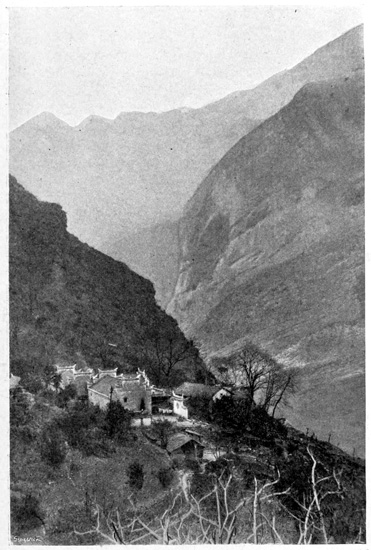
COUNTRY HOUSE IN YANGTSE GORGES.
By Mrs. Archibald Little.
In the towns the guilds represent family life on a larger scale. A man comes from Kiangsi, let us say, to Chungking, over a thousand miles away, and having probably spent months on the journey. He has brought no letters of introduction, but he straightway goes to the guild-house of his province, with its particularly beautiful green-tiled pagoda overlooking the river, a pale-pink lantern hanging from the upturned end of each delightful roof-curve, and there, making due reverence, he relates how he is So-and-so, the son of So-and-so, and straightway every one there knows all about him, and can easily ascertain if his story be correct. Here are friends found for him at once, a free employment agency, if that is what he is after, or a bureau of information about the various businesses of the city, their solvency and the like. Here is a lovely 540club-house, where he can dine or be dined, have private and confidential conversations in retired nooks, or sit with all the men of his province sipping tea and eating cakes, while a play is performed before them by their own special troupe of actors, who act after the manner of their province. I do not know who first started 541the legend that Chinese plays last for days, if not weeks. But it is not true, any more than that green tea is rendered green by being fired in copper pans and is poison to the nerves. Tea is green by nature, though it may be rendered black by fermentation, and is always fired in iron pans; and weak green tea as drunk in China is like balm to the nerves compared to Indian tannin-strong decoctions. In like manner Chinese plays are really short, though they make up in noise for what they lack in length.
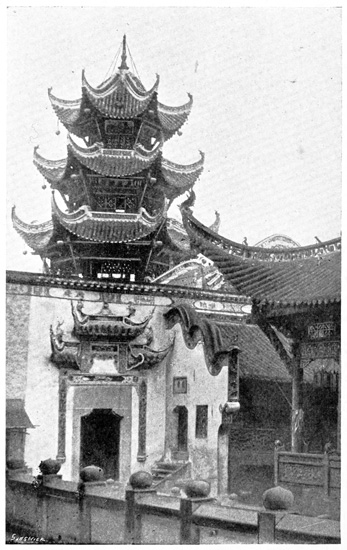
KIANGSI GUILD-HOUSE IN CHUNGKING.
By Mrs. Archibald Little.
If occasion needed, the guild would see after the newcomers funeral, even give him free burial if the worst came to the worst. And though we reckon the Chinese people such an irreligious race, and the guild-houses are naturally only frequented by men, chiefly by merchants (for the Chinese are a nation of traders), yet in every guild-house there is a temple. And before every great banquet part of the ceremony of marshalling the guests to their seats (and a very stately ceremony it is) is pouring a libation of wine before an altar in the banqueting-hall, before which also each guest bows in turn as he passes to the place assigned him.
But probably the custom that has the greatest effect upon Chinese life is that, just as twelve centuries ago they introduced competitive examinations, to which we have now in our nineteenth century of Christianity turned as to a sheet-anchor, so centuries ago the Chinese resorted to the principle of co-operation. In a Chinese business, be it large or be it small, pretty 542well every man in the business has his share; so that you are sometimes astonished when a merchant introduces to you as his partners a set of young men, who in England would be junior clerks. Even the coolie wrappering the tea-boxes says "We are doing well this year," and works with a will through the night, knowing he too will have his portion in the increased business this increased work signifies. The way, indeed, in which Chinese work through the night is most remarkable. Men will row a boat day and night for four or five days, knowing that the sum of money gained will thus be quicker earned, and only pausing one at a time to take a whiff at a pipe or to eat. They will press wool all through the night to oblige their employer without a murmur, if only given free meals whilst doing this additional work. The truth is, the habit of industry has been so engendered in Chinese as to be second nature, their whole system tending to encourage it, whilst ours, with our free poor-houses and licensed public-houses, tends rather in the other direction; our Trades Unions seem trying all they can to further diminish the incentives to good work on the part of skilled workmen by denying them any higher wage than that obtained by the incompetent. Co-operation after the Chinese model will, it is to be hoped, eventually put this right again. There is so much we might learn from the Chinese; but we have never followed the system we press upon Oriental nations, of sending out clever young students to other countries to see what they can learn that would be 543advantageous among our own people. In some ways China would serve as a warning. But a civilisation, that reached its acme while William the Norman was conquering England, and that yet survives intact, must surely have many a lesson to teach.
Besides all this mutual support and responsibility, Chinese customs are such that, as people often say somewhat sadly, you cannot alter one without altering all. The people here referred to are not the twenty-years-in-China-and-not-speak-a-word-of-the-language men, but Europeans who have tried to study the Chinese sympathetically. As it is, if you were to alter their houses and make them less draughty and damp, then all their clothing must be altered. That is again the case if you try to encourage them to play cricket—for which there is no sufficient level space in the west of China—or take part in other sports. But if you were to attempt to alter their clothing before you had rebuilt their houses, they would all be dying of dysentery or fever. In like manner, if you attempted to dragoon the Chinese into greater cleanliness, or into taking certain sanitary precautions, you would require a police force, which does not exist. But how to obtain that until you have got this self-respecting, self-governing people to see any advantage in being dragooned?
The solidarity of the Chinese race is one of the reasons it has lasted so long upon the earth, and its civilisation remained the same. It is twenty-one centuries since the Emperor Tze Hoang-ti said "Good government is impossible under a multiplicity of 544masters," and did away with the feudal system. It is twelve centuries since the Chinese found out what Burns only taught us the other day, that "A man's a man for a' that," and, giving up the idea of rank, began to fill posts by competitive examinations. Another of their most remarkable methods we shall probably copy whenever we begin seriously to consider Imperial Federation. They never send any man to be an official in his own province. Thus we should have Canadian officials in places of trust here or in Australia, and Australians in England or Canada. And to each province in China so many Government posts, civil and military, are assigned. If England had followed this method, there might be the United States of England now instead of America, for no system is better calculated to knit closely together the outlying regions of a great empire, than that in accordance with which every official in turn has to be examined as to his qualifications for office at the capital, and to return there to pay his respects to his sovereign before entering upon each new office.
The contemplation of China is discouraging: to think it got so far so long ago, and yet has got no farther! The Emperor Hoang-ti, who lived 200 B.C., may be supposed to have foreseen the deadening effect that government by literary men has upon a nation, for he burnt all their books except those that treat of practical arts. He was even as advanced as Mr Auberon Herbert, and warned rulers against the multiplication of unnecessary laws. Laotze, China's 545greatest sage, although too spiritually-minded a man to have gained such a following as was afterwards obtained by Confucius, again insists that the spiritual weapons of this world cannot be formed by laws and regulations: "Prohibitory enactments, and too constant intermeddling in political and social matters, merely produce the evils they are intended to avert. The ruler is above all things to practise wu-wei, or inaction."