Arrangement of a Chinese House.—Crowd in Streets.—My First Walk in Chungking City.—Presents.—Cats, Rats, and Eggs.—Paying a Call.—Ladies Affectionate.—Shocked at European Indecency.—Cost of Freight.—Distance by Post.—Children's Pleasures.—Precautions during Drought.—Guild Gardens.—Pretty Environs.—Opium Flowers, and Smokers.—Babble of Schools.—Chinese Girl-child
Arrangement of a Chinese House.—Crowd in Streets.—My First Walk in Chungking City.—Presents.—Cats, Rats, and Eggs.—Paying a Call.—Ladies Affectionate.—Shocked at European Indecency.—Cost of Freight.—Distance by Post.—Children's Pleasures.—Precautions during Drought.—Guild Gardens.—Pretty Environs.—Opium Flowers, and Smokers.—Babble of Schools.—Chinese Girlchild.
中國房屋的布局——街道上的人群——我在重慶市的第一次步行——禮物——貓、老鼠和雞蛋——拜訪——婦女的親熱——對歐洲人的不雅行為感到震驚——運費成本——郵寄距離——孩子們的樂趣——乾旱期間的預防措施——行會花園——漂亮的周邊環境——罌粟花和吸食者——學校的喧囂——中國女孩。
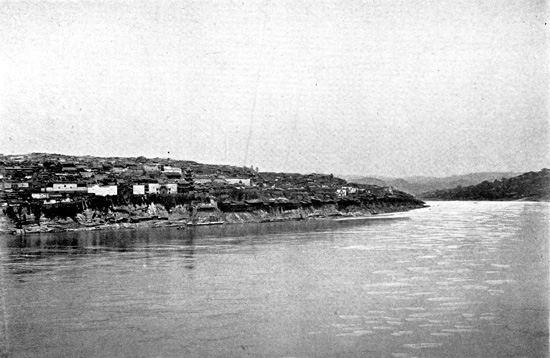
Chungking has been so fully described in my husband's volume Through the Yangtse Gorges, I will not here enter upon a description of it further than to say it is situated, like Quebec, at the junction of two rivers. It a little recalls Edinburgh; it is about the size of Lyons; has walls all round it; and its gates are shut at sunset, all but two, which remain open an hour or two longer, except when the country is in commotion. It is built upon a rock; and as the summer progresses all the rock warms up, till the heat is very great indeed. The streets are mostly covered over, both as a protection against the sun, and the rain, which is very frequent. There is thus no possibility of fresh air getting into its streets, short of a gale occurring; and there is only very rarely any wind, as is shown by the large shade-trees on the tops of the hills, and the77awnings to keep the sun off the houses, which are supported on bamboos, and which in this windless region are taken up even over the roofs of the houses.
重慶在我丈夫的書《穿越長江三峽》(Through the Yangtse Gorges)中已經有詳細描述,因此在這裡我不再多加描述,只簡單說明一下:它像魁北克(Quebec)一樣,位於兩條河流的交匯處。它有些讓人聯想到愛丁堡(Edinburgh),大約有里昂(Lyons)那麼大,四周環繞著城牆,日落時關閉城門,只有兩個城門會延遲一兩個小時關閉,除非鄉間發生動亂。城市建在一塊岩石上,隨著夏天的推進,整個岩石變得炙熱,氣溫非常高。街道大多有遮蓋,既是為了防曬,也為了遮雨,因為雨水非常頻繁。這樣的設計使得新鮮空氣無法進入街道,除非發生大風;而這裡幾乎沒有風,這可以從山頂的大樹和用竹子支撐的房屋遮陽篷看出來,在這個無風的地區,遮陽篷甚至會搭在屋頂上。
CHUNGKING, COMMERCIAL CAPITAL OF WESTERN CHINA.
Now all the missions have built European houses; but a little while ago all foreigners lived in Chinese houses within the walls of the city. To describe one: You enter off a dirty alley by a large gateway, the only opening in the lofty fire-proof walls that surround the whole property; for fire is the great danger of a Chinese city, and a whole quarter of Chungking has been burnt down since we have lived there. You pass into a sort of courtyard; from that you proceed by a long passage to another gateway, thence into a courtyard ornamentally laid out with pots and flowers. The house door opens from this; and entering by it, you find yourself in the lofty entrance hall, used by Europeans as a dining-room. Passing through an ornamental screen with open doorways, over which hang portières, you find yourself in a sitting-room, of which one wall and two half-walls consist of paper windows, with occasional panes of glass. On either side of these two principal rooms are long narrow ones, only thirteen feet wide, which for convenience their English occupants had divided into two, the end wall being in both cases again paper windows with occasional glass. Paper ceilings had been put in to prevent the dust falling through from the tiled roof above; but the sun would shine through this as well as the tiles quite brilliantly at times. None of the partition doors had handles or latches, and the outer walls, as well as the inside partitions, were all alike 78of thin planks of wood, not overlapping, and which would shrink in dry weather so as to leave quite large openings between them. It will thus be realised that, whatever was the temperature outside the house, the same was the temperature inside, with the additional disadvantage of draughts on rainy, wintry days; and in winter it generally rains in Chungking. Europeans always took care to secure wooden floors for themselves; but these floors were not uncommonly rotting away under their feet. And picturesque though the79houses are, with their lofty roofs, their solid wooden pillars, black rafters, and white plaster, their highly decorated exteriors, little pictures in black and white under the eaves, richly carved and heavily gilded ends to the beams, etc., it became increasingly evident each year that Europeans could not hope for health in them. Chinese in winter wear heavily wadded and fur-lined clothes, in which it is impossible to take exercise, and inside of which they loll about in a semi-comatose condition, much as if in bed.
重慶,西部中國的商業首都
如今,所有的傳教士都建了歐式房屋;但在不久前,所有外國人都住在城內的中國房屋中。要描述其中一座房屋:你從骯髒的小巷進入一個大門,這是環繞整個房產的高大防火牆中唯一的開口;因為火災是中國城市的一大威脅,自從我們住在重慶以來,整個城區的一部分已經被燒毀。你進入一個類似於庭院的地方,然後經過一條長長的通道到達另一個門,再從那裡進入一個裝飾有花盆和花卉的庭院。房子的門從這裡打開,進入後,你會發現自己置身於高大的入口大廳,歐洲人將其用作餐廳。穿過一個裝飾性的屏風,上面掛著門簾,你會發現自己在一個客廳裡,這裡的一面牆和兩面半牆是紙窗戶,偶爾有玻璃窗格。這兩個主要房間的兩側是狹長的房間,寬僅13英尺,英國住戶為方便起見將其分為兩部分,盡頭的牆壁也是紙窗戶,偶爾有玻璃窗格。安裝了紙天花板以防止塵土從上方的瓦頂落下;但有時陽光會穿透瓦片和紙天花板,非常明亮。
所有隔間門都沒有把手或門閂,外牆和內部分隔都是薄木板,不重疊,乾燥天氣時會收縮,留下相當大的縫隙。因此,不管屋外的溫度如何,屋內的溫度也一樣,並且在雨天和冬天會有風穿堂而過;冬天的重慶通常下雨。歐洲人總是設法為自己鋪設木地板;但這些地板通常會在他們腳下腐爛。儘管這些房屋非常美觀,有著高聳的屋頂,堅固的木柱,黑色椽子和白色灰泥,高度裝飾的外觀,屋簷下的小黑白畫作,雕刻精美並重度鍍金的梁端等,每年越來越明顯的是,歐洲人無法在這些房屋中保持健康。中國人在冬天穿著厚重的棉襖和毛皮襯裡的衣服,無法進行運動,並在這些衣服內部處於半昏迷狀態,像在床上一樣懶散地躺著。

DINNER PARTY IN THE GARDEN OF A MEMBER OF THE HANLIN COLLEGE,—WHITE CLOTH SPREAD IN COMPLIMENT TO EUROPEANS. By Mrs. Archibald Little.
在翰林院\[Hanlin College\]成員的花園中的晚宴——鋪設白布以示對歐洲人的敬意。 作者:阿奇博爾德·利特爾夫人\[Mrs. Archibald Little\]
The streets, although wide for a Chinese city, are very narrow in comparison with English streets, being only eight feet at the widest, and extraordinarily crowded. Passing through them is a continual pushing through a crowd of foot-passengers; of sedan-chairs, carried by coolies, with sometimes one or two men running before to clear the way, and if it be necessary beat back the crowd; of mules, donkeys, or ponies, with loads; and of numbers of carrying-coolies, a bamboo across their shoulders, and from either end a basket hanging by strings. Everything that can be done in the streets is done in them: pedlars go by with great quantities of goods for sale; men are mending broken china with little rivets after a fashion in which the Chinese are great experts; here is a barber shaving a man's head, there are two women menders, on little stools very neatly dressed, pursuing their avocation; here is a man working at an embroidery-frame, there a cobbler mending shoes; here some pigs, there some chickens; here a baby in a hen-coop, there a pussy-cat tied to a shop-counter; 80and in the evenings street preachers, in the afternoons vast crowds pouring out from theatres. At night, in going out to dinner we used always to pass at least three street preachers. These men wear official caps, and are as a rule, I believe, reading or expounding the Sacred Edicts. There is always a little crowd listening, though often a very small one. In the better streets every attention is paid to decency; in the lesser streets none is apparent. At the street corners there are often large tanks full of water, as a precaution against fire. These are invariably grown over with weed. A vast army of coolies is every day going down the steep flights of steps to the river to bring water, which drips from the buckets as it is carried along. Another army is carrying out the sewage of the city to be used 81as manure. A very soft coal is used for fuel; and baskets of coal are constantly being carried in, two dangling from a pole across a coolie's shoulders. The coal-dust, and the smoke, and the drippings, and the bustling crowd, all make the streets rather an unpleasant place to walk in. Yet, although every one told me it was impossible for an English lady to walk in them, I felt it was impossible for me to live in Chungking unless I did; for in summer no one could walk out till sunset, and then the gates are closed; so after showing myself about as much as I could in a sedan-chair with the curtains up—unlike the other ladies, who all kept theirs down in those days—I determined to attempt a walk, with my sedan-chair, of course, following behind to show I had some claim to respectability.