A Concubine no Empress.—Sudden Deaths.—Suspicions.—Prince Ch`ün.—Emperor's Education.—His Sadness.—His Features.—Foreign Ministers' Audience.—Another Audience.—Crowding of the Rabble.—Peking's Effect on Foreign Representatives.
妃嬪非皇后。—突然死亡。—疑點重重。—醇親王(Prince Ch`ün)。—皇帝的教育。—他的悲傷。—他的特徵。—外國使節的聽眾。—另一場聽眾。—烏合之眾的擁擠。—北京(Peking)對外國代表的影響。
According to Chinese usage or unwritten law, the concubine of an Emperor can never become Empress-Dowager; yet Tze Hsi, the concubine of the Emperor Hien Fêng, and mother of the late Emperor Tung Chih, has ruled over China in this capacity since 1871. For a time she nominally shared the power with Tze An, the childless widow of the Emperor Hien Fêng. In like manner for a while the youthful Kwang-shü, her step-sister's son, has been nominal Emperor. But the ease with which she resumed the reins in September, 1898, sufficiently shows that she had never really let go of them. Tze, which was also the name of the late Empress Tze An, means "parental love," whilst An means "peace." Hsi, the second name of the present Empress, means "joy," and is pronounced she. Tze Hsi is undoubtedly a remarkable woman. Besides having directed the 516destinies of China for twenty-seven years, without being in the least entitled to do so, she is said to be a brilliant artist, often giving away her pictures; and she also writes poetry, having even presented six hundred stanzas of her poetry to the Hanlin College. Some people suspect her of having been instrumental in causing the death of the Emperor Hien Fêng, as also of his and her son Tung Chih. She is more than suspected of having caused the death of her sister, the mother of the Emperor Kwang-shü. The two ladies had a violent altercation about the upbringing of the child, and two days after his mother died—of pent-up anger in the heart, it was announced. The beautiful Aleute, widow of her son Tung Chih, certainly died by her own hand, which is considered a very righteous act on the part of a widow; but had her mother-in-law, the Empress Tze Hsi, not thought that she might become a dangerous rival, probably Aleute would not have killed herself.
根據中國的習俗或不成文的法律,皇帝的妃嬪不能成為皇太后;然而,賢豐皇帝的妃嬪慈禧,自從1871年以來一直以皇太后的身份統治中國。曾有一段時間,她名義上與賢豐皇帝無子的遺孀慈安共享權力。同樣,慈禧的繼妹之子光緒也曾一度名義上是皇帝。但她在1898年9月輕鬆地重新掌握權力,充分表明她從未真正放手。慈,即已故慈安皇后的名字,也意味著“慈愛”,而安意味著“和平”。禧,現任皇后的第二個名字,意味著“喜悅”,發音為“she”。毫無疑問,慈禧是一個了不起的女人。除了在毫無合法權利的情況下指導中國的命運長達二十七年之外,據說她還是一位出色的藝術家,經常送出她的畫作;她也寫詩,甚至向翰林院贈送了六百首詩。有些人懷疑她是造成賢豐皇帝和她的兒子同治皇帝死亡的原因。她還被懷疑導致了她的妹妹,即光緒皇帝的母親的死亡。這兩位女士因孩子的撫養問題發生了激烈的爭吵,兩天後,光緒皇帝的母親因心中積鬱的憤怒而去世。她的兒子同治的遺孀美麗的阿魯特確實自殺了,這被認為是寡婦的一種非常正義的行為;但如果她的婆婆慈禧皇后不認為她可能成為一個危險的對手,阿魯特可能不會自殺。
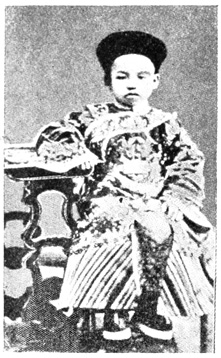
EMPEROR KWANG-SHÜ, 1875. Lent by Society for Diffusion of Christian and General Knowledge in China. 光緒皇帝,1875年。 由中國基督教和一般知識傳播協會(Society for Diffusion of Christian and General Knowledge in China)提供。
It is of course well known that Kwang-shü was not the natural successor to Tung Chih. He was simply chosen as Emperor by his ambitious aunt because he was the very youngest person who had any claim, and 517she thus secured to herself a longer lease of power. Her sister was notoriously averse to it, and the little Kwang-shü was stolen by the Empress Tze Hsi from his cradle to bear the burden of an honour unto which he was not born. The child is reported to have cried. He was then four years old. His father was the poetical Prince Ch`ün, who made one great tour, and wrote a collection of poems on the novel objects he saw during his travels. An Englishman, who knew him, describes him as rather jovial than otherwise, but his portrait hardly confirms this description. He was certainly respected during his lifetime, and after his death, as before mentioned, he was extolled in the Peking Gazette for the meekness with which he had abstained from arrogating to himself high place, in spite of being the father of an Emperor. Probably, however, his life would have ended sooner if he had, and he knew it. As it was, there were suspicious circumstances about his death, as some people thought there were about that of the Marquis Tseng, a former Chinese Minister very popular in England, whilst he resided here. Dr. Dudgeon, years ago a member of the London Mission, was his medical adviser, and he himself relates how Li Hung-chang, celebrated for his abrupt speeches, accosted him with, "Well, and how much did you get for poisoning the Marquis Tseng?" "I poison the Marquis Tseng! That was very foolish of me, considering he was my best-paying patient." Then, after a pause, "But if I did, how much was it your Excellency paid me to put him out of the way?" Li Hung-chang 518lay back in his chair and chuckled, not offended but delighted with the retort. But although the Marquis Tseng, there is every reason to suppose, died of illness, it seems impossible to say so of Prince Kung, who opposed the policy of the Empress Tze Hsi, and died almost directly afterwards, as was again said, of pent-up anger.
The quarrel between the Empress and her sister was about the method of education of the youthful Kwang-shü. The former is openly accused of having taught him to play cards and drink wine. And the marvel is, not that Kwang-shü is a young man of weak physique, and lacking in the characteristics of a Cromwell or a Bismarck, but that he is, in spite of all, a young man with aspirations and a real wish for his country's good. During all my stay in China I have never heard one single story to his disadvantage, except that at one time people had an idea he was subject to epileptic fits, which seems not to have been true, and that ten or twelve years ago I have heard it said that at times he had ungovernable fits of rage, during which he would throw anything that came handy at the heads of those who opposed him. This may have been true—he was but a boy at the time—but the story has never been confirmed, nor were those who told it the least confident that it was true. From Chinese I have heard but one account: "The Emperor is good. But what can he do?" Of the Empress, on the other hand, there seems but one opinion—that she loves money. Sometimes people add that she has taken with ardour to gambling. But never 519have I heard any Chinaman suggest that she had the least care of any sort for the interests of China or the Chinese. They do not speak of her as clever. They speak of her generally in connection with Li Hung-chang, the unscrupulous; and they shake their heads over them both. According to report, she has a piercing eye. But a lady, who had been some years in the Palace embroidering, seemed surprised at hearing this, and implied that she had never noticed it.
I have heard many descriptions of the young Kwang-shü. They all agree on one point—that he looks sorrowful. "Very sorrowful?" I asked the other day of an Englishman, who had seen him just before his deposition. "Yes, very sorrowful." "Sick and sorrowful? or more sorrowful than sick?" "More sorrowful than sick." A private letter I once saw, written by a man fresh from being present at an audience, gave the impression of his being altogether overcome by the youthful Emperor's sadness, which, as far as I remember, was described as a cloud, that seemed to envelop him, and remove him from the rest of the world. This sadness seemed to be heightened by an extreme sweetness of disposition. The youthful Emperor smiled on seeing the beautifully illuminated book in which the German address of congratulation was presented, looked at it for a moment, then laid it down, and once more was so full of sorrow it was impossible to contemplate him without emotion. If my memory serves me, the writer used stronger, more high-flown expressions than I am daring to make use of. Repeating 520them at the time to the Secretary who had accompanied the British Minister, I asked him if the Emperor had made at all the same impression upon him. He paused a moment, looking grave; then said firmly, "Yes, I think quite the same."
眾所周知,光緒並非同治的自然繼承人。他只是被他那雄心勃勃的姑母選為皇帝,因為他是唯一有資格繼承皇位的最年幼者,她因此得以確保自己更長時間的權力。她的妹妹明顯不贊成這一決定,而小光緒則被慈禧太后從搖籃中偷走,承擔了這個他不應承擔的榮譽。據說當時這個孩子哭了,那時他只有四歲。他的父親是詩人醇親王,曾進行過一次大型旅行,並寫了一本詩集,描述他旅行中見到的新奇事物。一位認識他的英國人形容他為一個相當快活的人,但他的肖像並未完全證實這一描述。在他生前和死後,他無疑都受到尊敬,如前所述,他在《北京公報》中被稱讚為一個謙卑的人,儘管他是皇帝的父親,但他從未奪取高位的謙遜。然而,可能他的生命如果他爭奪高位,會更早結束,而他自己也知道這一點。儘管如此,他的死亡仍有可疑之處,就像一些人認為曾在英國非常受歡迎的前中國大臣曾國藩之死也有可疑之處一樣。多年前曾是倫敦傳教會成員的杜德仁博士是他的醫生,他自己講述了李鴻章著名的直言不諱的言論如何問他,“那麼,你因毒死曾國藩得了多少錢?” “我毒死了曾國藩!這對我來說很愚蠢,因為他是我最好的付費病人。” 然後,經過一段停頓,“但如果我真做了,你閣下給了我多少錢讓我把他除掉?”李鴻章躺在椅子上笑了起來,對這一反駁並不生氣,而是感到高興。儘管曾國藩很可能是因病去世,但對於反對慈禧太后政策的恭親王,他的死似乎無法這樣說,他幾乎在反對之後馬上去世了,據說是因為積壓的憤怒而死。
慈禧和她妹妹之間的爭吵是關於年幼的光緒的教育方法。前者被公開指責教他玩牌和喝酒。奇蹟的是,光緒並非一個弱小體質,且缺乏克倫威爾或俾斯麥的特徵的年輕人,而是一個有抱負並真心希望國家好的年輕人。在我逗留在中國期間,從未聽過一個對他不利的故事,除了有一段時間人們認為他可能患有癲癇發作,這似乎不是真的,而且十幾年前我聽說他有時會發生無法控制的憤怒發作,期間他會把手邊的東西扔向反對他的人頭上。這可能是真的——那時他還是個孩子——但這個故事從未被證實,講述它的人也並不十分確信它的真實性。從中國人那裡,我只聽到一個說法:“皇帝是好的,但他能做什麼呢?”另一方面,對於慈禧,似乎只有一種意見——她愛錢。有時人們補充說,她熱衷於賭博。但從未聽過任何中國人建議她對中國或中國人的利益有絲毫關心。他們不說她聰明。他們通常把她和無所顧忌的李鴻章聯繫在一起,並對他們兩個搖頭。據報導,她有一雙銳利的眼睛。但一位在宮廷裡繡花多年的人似乎對此感到驚訝,並暗示她從未注意到這一點。
我聽過很多關於年輕的光緒的描述。他們都同意一點——他看起來很悲傷。“非常悲傷嗎?”我前幾天問一位在他被廢黜前見過他的英國人。“是的,非常悲傷。”“是病痛還是悲傷?還是悲傷多於病痛?”“悲傷多於病痛。”我曾看過一封私人信件,是一個剛參加過一次聽證會的人寫的,給人的印象是他被年輕皇帝的悲傷完全壓倒了,據我記憶,這被描述為一種雲霧,似乎把他與世界其他部分隔離開來。這種悲傷似乎因一種極度甜美的性情而加劇。年輕的皇帝在看到那本美麗的燈書,德國的賀詞時微笑了一下,看了一會兒,然後放下它,再次充滿悲傷,讓人無法不感到情緒波動。如果我沒記錯,那位作者用了比我敢用的更強烈、更華麗的表達方式。我當時把這些話重複給陪同英國大臣的秘書,問他皇帝是否給他留下了同樣的印象。他停了一會兒,面色凝重,然後堅定地說:“是的,我想完全一樣。”
Here is an extract from an account written on the occasion of the audience of the Diplomatic Corps in 1891:
"All interest, however, centred in the Emperor himself. He looks younger even than he is, not more than sixteen or seventeen. Although his features are essentially Chinese, or rather Manchu, they wear a particular air of personal distinction. Rather pale and dark, with a well-shaped forehead, long, black, arched eyebrows, large, mournful, dark eyes, a sensitive mouth, and an unusually long chin, the young Emperor, together with an air of great gentleness and intelligence, wore an expression of melancholy, due, naturally enough, to the deprivation of nearly all the pleasures of his age and to the strict life which the hard and complicated duties of his high position force him to lead. As he sat cross-legged, the table in front hid the lower part of his person. In addressing Prince Ch´ün, he spoke in Manchu rather low and rapidly, being perhaps a little nervous."
And now it may be well to give a translation of the best account I know, that of the Ost Asiatische Lloyd, of the audience of the Foreign Ministers in Peking at the celebration of the sixtieth birthday of the Empress-Dowager.521
"Early in the present month the Representatives of the Treaty Powers in Peking were officially informed by Prince Kung, the new President of the Tsung-li Yamen, that the Emperor desired to receive the Foreign Ministers in audience in celebration of the sixtieth birthday of the Empress ex-Regent; and, further, that, as a special mark of good-will, the audience would be held within the precincts of the Inner Palace—i.e. in the so-called 'Forbidden City.' This audience took place on Monday, November 12th.
"The theatre of this solemn function of State was the Hall of Blooming Literature, a somewhat ancient building in the south-east quarter of the Palace, which is used for the annual Festival of Literature, held in the second month, on which occasion the Emperor receives addresses on the Classics from distinguished members of the Hanlin College. According to a Japanese work, entitled A Description of Famous Places in the Land of Tang (*i.e.*China), which gives an illustrated description of the ceremony, all the Presidents and Vice-Presidents of the different Ministries in Peking, as well as high office-bearers, have then to be present.
"On the present occasion the Representatives of the Foreign Powers and their suites entered by the Eastern Flowery Gate, which is the sole entrance in the east wall of the Inner Palace. The sedans were left there, and the visitors proceeded on foot through a wide walled-in courtyard, past the Palace garden, to the Hall of Manifested Benevolence, a smaller threefold building in which formerly offerings were made to 522the mythical Emperors and to the ancient worthies, and which was utilised on this occasion as waiting-room for the Ambassadors. These were now received by the Princes and Ministers of the Tsung-li Yamen, and thence conducted, after a short delay, through the Wen-hua pavilion. From there the Envoys and their suites were conducted to the audience chamber by two Palace officials, and then led to the throne by two Ministers of the Tsung-li Yamen. At twenty minutes before twelve o'clock the doyen of the Diplomatic Corps, the Ambassador of the United States, was presented, while the others followed in order of seniority. The remainder of the ceremony was carried out as at previous audiences. The Ambassador, followed by his suite, approached the dais with three bows, and saluted the Emperor seated thereon at the top of a flight of steps: he then spoke a few words commemorating the solemn occasion. The letter of felicitation from his sovereign was then handed in, after each respective Embassy interpreter had translated it into Chinese; it was then taken by Prince Kung or Prince Ch`ing, who stood at the Emperor's side and acted alternately with each presentation, and translated by them into Manchu. The Prince in question then laid the letter on a table covered with yellow silk before the Emperor. The monarch inclined his head as he received it, then spoke a few sentences in an audible tone to the Prince kneeling at his left, in which he expressed his delight and satisfaction. The Prince, after leaving the dais, repeated the Emperor's words in Chinese to the interpreter, who again repeated them in the language of his country to the Ambassador.
眾所周知,光緒並非同治的自然繼承人。他只是被他那雄心勃勃的姑母選為皇帝,因為他是唯一有資格繼承皇位的最年幼者,她因此得以確保自己更長時間的權力。她的妹妹明顯不贊成這一決定,而小光緒則被慈禧太后從搖籃中偷走,承擔了這個他不應承擔的榮譽。據說當時這個孩子哭了,那時他只有四歲。他的父親是詩人醇親王,曾進行過一次大型旅行,並寫了一本詩集,描述他旅行中見到的新奇事物。一位認識他的英國人形容他為一個相當快活的人,但他的肖像並未完全證實這一描述。在他生前和死後,他無疑都受到尊敬,如前所述,他在《北京公報》中被稱讚為一個謙卑的人,儘管他是皇帝的父親,但他從未奪取高位的謙遜。然而,可能他的生命如果他爭奪高位,會更早結束,而他自己也知道這一點。儘管如此,他的死亡仍有可疑之處,就像一些人認為曾在英國非常受歡迎的前中國大臣曾國藩之死也有可疑之處一樣。多年前曾是倫敦傳教會成員的杜德仁博士是他的醫生,他自己講述了李鴻章著名的直言不諱的言論如何問他,“那麼,你因毒死曾國藩得了多少錢?” “我毒死了曾國藩!這對我來說很愚蠢,因為他是我最好的付費病人。” 然後,經過一段停頓,“但如果我真做了,你閣下給了我多少錢讓我把他除掉?”李鴻章躺在椅子上笑了起來,對這一反駁並不生氣,而是感到高興。儘管曾國藩很可能是因病去世,但對於反對慈禧太后政策的恭親王,他的死似乎無法這樣說,他幾乎在反對之後馬上去世了,據說是因為積壓的憤怒而死。