The Emperor at the Temple of Heaven.—Mongol Princes wrestling.—Imperial Porcelain Manufactory.—Imperial Silk Manufactory.—Maids of Honour.—Spring Sacrifices.—Court of Feasting.—Hunting Preserves.—Strikes.—Rowdies.—Young Men to be prayed for.
皇帝在天壇——蒙古王子摔跤——御窯廠——御織局——女官——春祭——宴會——狩獵場——罷工——惡棍——為年輕人祈禱。
Almost all we can know of the Emperor of China is by hearsay. He lives in his Palace inside the Forbidden City, which again is inside the Manchu City, separated from the Chinese City, where are the lovely, gilded curio shops. When he goes abroad, which he never does, except to worship at the temples, all the people are ordered to keep within-doors, and the most any outsider can do is to peep at him through the crack of a door or from behind a curtain. But as I think some details of his State may be interesting to the general reader, and indeed would well repay thinking over, I have extracted an abridged translation from a Chinese newspaper's account of the present Emperor Kwang-shü's visit to the Temple of Heaven in 1888, when, it must be remembered, he was only a boy between sixteen and seventeen. Those who do not care for the accounts of pageants can 494easily skip it. Those who read it will, however, learn much of Chinese usage therefrom, and will perhaps better realise how remarkable must be the character of the lad who, brought up from the age of four as the central figure in such ceremonies, yet dared to place himself at the head of the party of progress, and to introduce innovations. People in England, angry with him for being overcome, think he must be a young man of weak character. But contrast him with one of our European princes, read what he has attempted, which I hope to describe in a following chapter, and then decide which is the stronger character. Kwang-shü has always been of weak physique—not unnaturally, considering that he has never known what it is to go out into the country, and take free, healthy exercise. But probably this has been his salvation. Had he been a young man of strong physique, he could never, probably, have withstood the promptings of his own nature, together with those temptations of wine and women, by which he has been surrounded from his earliest years. That he should not have taken proper precautions for his own protection and that of his supporters is hardly wonderful, considering that from babyhood he has been treated as too august a personage even to be seen. Probably he had learnt to believe his will was law, and must be executed. It is little wonder if he now looks ill and his wife sorrowful, even if the suspicions of poison be unfounded.
我們對中國皇帝的了解幾乎全憑傳聞。他住在紫禁城內的皇宮,這座皇宮又位於滿城內,與那些擁有華美金飾的古董店所在的中國城區隔絕開來。當皇帝出行時,他只會去寺廟禮拜,所有百姓都被命令待在家中,外人最多只能透過門縫或從窗簾後偷看他。但我認為關於他的國事細節對普通讀者可能頗具吸引力,實際上也值得深思。因此,我摘錄並翻譯了一篇來自中國報紙的報導,描述了當今皇帝光緒在1888年參拜天壇的情景。當時,他還只是一個十六到十七歲的少年。不喜歡閱覽盛典記述的人可以跳過這部分。但閱讀這篇報導的人將會從中學到許多中國的習俗,也許會更好地理解這位少年在四歲起就成為這些儀式中心人物的非凡性格,他竟然敢於站在改革派的最前列,引入創新。英國的人們因他遭受挫敗而對他感到憤怒,認為他一定是一個性格軟弱的年輕人。但如果將他與我們的歐洲王子相比,閱讀他所嘗試的事蹟(我希望在下一章中描述),再來判斷誰的性格更為堅強。光緒一直體弱多病——這並不奇怪,因為他從未知道什麼是到鄉間去,進行自由而健康的鍛煉。但這或許成了他的救贖。若他是一個身體強壯的年輕人,他可能無法抵抗來自自己天性的誘惑,以及從小就被美酒和女人所包圍的誘惑。他未能採取適當的措施來保護自己和他的支持者,這一點並不令人驚訝,畢竟他從嬰兒時代起就被視為過於神聖而不可見的人物。他可能已經習慣了自己的意志就是法律,必須被執行。如果他現在看起來病容滿面,他的妻子也滿是憂愁,即使對毒藥的懷疑是無根據的,這也不足為奇。
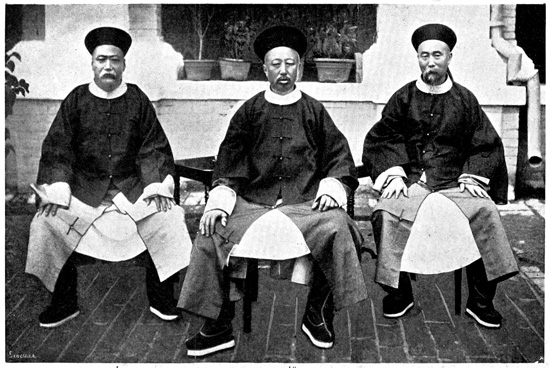
SHAN CH'ING. PRINCE CH'ÜN. LI HUNG-CHANG. Son of general (Tartar). Emperor's father (Manchu). (Chinese.)
"On February 20th, 1888, the Emperor of China 497went in person to the Temple of Heaven to pray for the harvest, with the usual ceremonies. The day before his Majesty passed in the Hall of Abstinence, in prayer, fasting, and meditation.
"On February 19th, at the fifth drum (the fifth watch, before daylight), the Tai Chang Sze (a high bureau entrusted with the arrangement of such ceremonials) placed a Yellow Table (the Imperial colour) in the Hall of Great Harmony, the T`ai-hwo Tien. South of the Emperor's seat was placed an incense-burner, shaped like a small pavilion; and in another similar erection, east of the left-hand pillars, stood a scroll, on which a sentence of prayer was painted in the choicest caligraphy. To the west of the right-hand pillars of the building stood yet another pavilion, to contain the mounted rolls of silk, which were painted with similar inscriptions. The Masters of Rites and the Readers of Prayers stood respectfully waiting outside the gate of the Hall of Great Harmony, holding in front of them the silken scrolls in baskets and the incense in bronze censers.
"The Chief of the Ceremonial Bureau, already mentioned, called by Mr. Mayers the Court of Sacrificial Worship, accompanied by other officers of the Bureau, was waiting inside the Hall; and when the time arrived, he proceeded, with the Imperial Astronomer, to the Gate of Pure Heaven, to announce to the Emperor that it was two quarters of the Hour of the Hare (i.e. 6.30 a.m.), and his Majesty issued from the above-named gate, riding in a sedan-chair, passed through 498the back left gate, and thus to the Hall of Great Harmony, where his sedan-chair was deposited at the northern steps, and he entered the building and stood in front of the left pillars, facing the west.
"Four officials of the Hanlin, or Imperial Academy of Literature, were standing outside the right-hand door of the building, facing east. The Readers of Prayers now issued from the inner cabinet, holding in front of them, respectfully elevated, prayers written on scrolls of paper, and entered the middle gate of the Hall of Great Harmony, the silken scrolls and incense being borne after them into the Hall. In front of them were borne a pair of incense-burners. The Masters of Rites, ten in number, conducted them, preceding them, and mounted the central steps as far as to the Vermilion Dais. The Readers of Prayers, those who bore the prayer-scrolls, and the bearers of silken scrolls and incense, having entered the central gate of the Hall, reverently laid down their burdens one by one on the Yellow Table, and retired after three k`otows (prostrations), touching the ground with the forehead.
"1888年2月20日,中國皇帝親自前往天壇祈求豐收,並進行了一系列的儀式。前一天,皇帝在齋戒堂內度過,進行祈禱、禁食和冥想。
"2月19日,於第五更(即天亮前的第五次打更),太常寺(負責安排這類儀式的高級機構)在太和殿內設置了一張黃色桌子(象徵皇室的顏色)。皇帝座位南側放置了一個小亭子形狀的香爐;在左側柱子東邊的另一個類似的建築物中,放置了一幅卷軸,上面用最優美的書法寫著一句祈禱詞。在建築物右側柱子的西邊,還有另一個小亭子,裡面放置著寫有類似文字的絲絹卷軸。禮儀大師和祈禱文朗讀者在太和殿門外恭敬地等待,手持裝在籃子裡的絲絹卷軸和銅香爐中的香。
"之前提到的儀式局長官,也被馬爾斯先生稱為祭祀禮儀局,與其他局內官員一起,在大殿內等待。當時間到來時,他與御天文官一起前往天清門,向皇帝報告時辰為兔時兩刻(即早上六點半),皇帝從上述大門乘轎而出,經左後門,來到太和殿北階下,轎子在此卸下,皇帝步入大殿,站在左側柱子前,面向西方。
"四位翰林院官員站在大殿右側門外,面向東方。此時,祈禱文朗讀者從內閣中出來,手持用紙寫成的祈禱文卷軸,恭敬地舉起,進入太和殿的中門,隨後是絲絹卷軸和香。前面是兩個香爐。十位禮儀大師引導他們,走在前面,登上中央台階至朱紅色的平台。祈禱文朗讀者、祈禱文卷軸的持有者以及絲絹卷軸和香的持有者進入大殿的中門後,逐一恭敬地將其放在黃色桌子上,並在三次叩首後退下,額頭觸地。
"The Chief of the Court of Sacrifice then opened a prayer-scroll, and the Master of Rites spread a cushion on the ground. The Emperor advanced in front of the Yellow Table, and reverentially inspected the objects lying on it, after which he performed the genuflection called 'once kneel and thrice k´otow,' and then took up his position again, standing as before. The Chief of the Court of Sacrifice rolled up the prayer-scroll 499again, and the cushion on which the Emperor had just knelt was removed.
"The Readers of Prayers now advanced to the Yellow Table, and made three k´otows. They respectfully took from the table and bore aloft the prayer-scrolls, the silken scrolls, and the incense, which they deposited one by one in the graceful pavilionlike stand meant to receive them. With three more k´otows, they retired.
"The mandarin in charge of the incense now carried a box full of incense to the incense-stand, placed it gently there, and withdrew.
"The bearers of the prayer-scrolls then left the edifice by the central door, the stand containing the incense preceding them, and that which contains the silken scrolls following behind. The Chief of the Court of Sacrifice, kneeling, informed the Emperor that this part of the solemn rite was over.