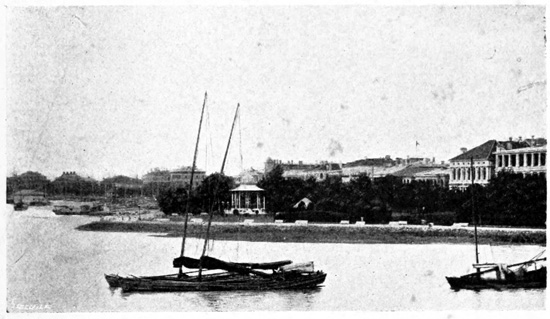
SHANGHAI FROM THE RIVER.
Arriving in Shanghai.—My First Tea-season.—Inside a Chinese City.—Shanghai Gardens.—In the Romantic East at last!
抵達上海。—我的第一個茶季。—中國城市內部。—上海花園。—終於置身於浪漫的東方!
It was in the merry month of May, 1887, that I first landed in China; but from the first there was nothing merry about China. It felt bitterly cold, after passing through the tropics; and in Shanghai one shivered in a warm wrap, as the wind blew direct from the North Pole straight at one's chest, till one day it suddenly turned quite hot, and all clothes felt too heavy. Every one almost knows what Shanghai is like. It has been admirably described over and over again, with its rows of fine European houses fronting 2the river, the beautiful public gardens and well-trodden grass-plats interposed between the two; with its electric lights and its carriages, and great European stores, at which you can buy everything you could possibly want only a very little dearer than in London. There used to be nothing romantic or Eastern about it. Now, darkened by the smoke of over thirty factories, it is flooded by an ever-increasing Chinese population, who jostle with Europeans in the thoroughfare, till it seems as if the struggle between the two races would be settled in the streets of Shanghai, and the European get driven to the wall. For the Chinaman always goes a steady pace, and in his many garments, one upon the top of the other, presents a solid, impenetrable front to the hurrying European; whilst the wheelbarrows on which his womankind are conveyed rush in and out amongst the carriages, colliding here and there with a coolie-drawn ricksha, and always threatening the toes of the foot-passenger. Too often there are no foot-pavements, and the whole motley crowd at its very varying paces is forced on to the muddy street. Ever and anon even now a closed sedan-chair, with some wealthy Chinaman from the adjacent Chinese city, threads its way in and out among the vehicles, noiseless and stealthy, a reminder of China's past glories. There are also now wholly Chinese streets in the foreign settlement, where all the shop-fronts are gorgeous with gilding and fine decorative Chinese characters, where all the shops have signs which hang perpendicularly across the street-way, instead of horizontally over 3the shop-front as with us, and where Chinese shopkeepers sit inside, bare to the waist, in summer presenting a most unpleasing picture of too much flesh, and in winter masses of fur and satin.
1887年五月,那個愉快的月份,我首次登陸中國;但自始至終,中國並沒有任何愉快之處。穿過熱帶地區後,感覺異常寒冷;在上海,北極直吹的寒風直撲胸膛,即使穿著溫暖的外套也會凍得瑟瑟發抖,直到某天,突然變得極熱,所有衣服都嫌厚了。幾乎人人都知道上海是什麼樣子。它早被精彩描述過,歐洲風格的精美房屋陳列河邊,間以美麗的公共花園,草坪上時見有人來往;電燈、馬車和大型歐洲商店,這裡可以買到幾乎所有所需之物,價格略高於倫敦。過去它沒有任何浪漫或東方色彩。如今,三十多家工廠的煙霧裡它變得黯淡,被越來越多的中國人口淹沒,他們在街道上與歐洲人摩肩接踵,似乎兩個種族之間的鬥爭將在上海的街頭解決,歐洲人被趕到了牆角。因為中國人總是穩步前進,穿著一層又一層的衣服,向匆忙的歐洲人展示了一個堅實、無法穿透的前方;女性坐在獨輪車上穿梭於馬車之間,時不時與苦力拉的黃包車相撞,總是威脅著行人的腳趾。多數沒有步行道,五花八門的人群以不同的速度被迫擠到泥濘的街道上。不時甚至現在,來自附近城市的富人坐著封閉的轎子,在車輛中穿梭,悄無聲息,提醒著中國昔日的輝煌。在外國租界中,現在還有完全中國化的街道,所有的店面都裝飾著華麗的金箔和精美的中國字樣,所有的商店都掛著垂直於街道的招牌,而不是像我們水平掛在店面上,中國店主在裡面坐著,夏天赤裸上身,肉體橫陳,冬天則穿著厚厚的皮毛和緞子,呈現出令人不快的畫面。
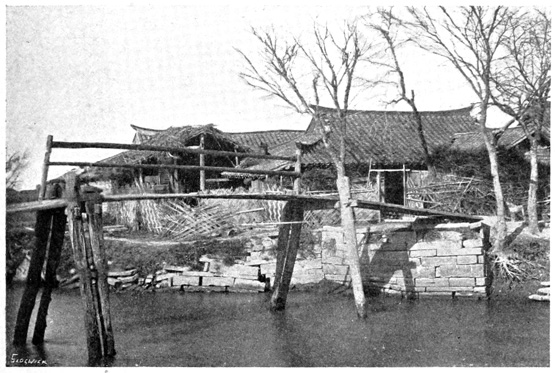
SHANGHAI CREEK, WITH DRAWBRIDGE.
Shanghai has got a capital racecourse, and theatre, and cricket-ground—grounds for every kind of sport, indeed. It has a first rate club, and an ill-kept museum. Its sights are the bubbling well and the tea-garden in the China town, believed by globe-trotters, but erroneously, to be the original of the willow-pattern plate. Beside this, there is what is called the Stone Garden, full of picturesque bits. A great deal that is interesting is to be seen in the China town by those who can detach their minds from the dirt; in one part all the houses have drawbridges leading to them. But 4even the Soochow Road in the foreign settlement has never yet been treated pictorially as it deserves. It is the Palais Royal of Chinese Shanghai. At the hour when carriage traffic may only pass one way because of the crowd, it would reward an Alma-Tadema to depict the Chinese dandies filling all its many balconies, pale and silken clad, craning their necks to see, and by the haughtiness of their gaze recalling the decadent Romans of the last days of the empire. Their silken garments, their arched mouths, the coldness of their icy stare, has not yet been duly depicted. Chun Ti Kung, by the late Mr. Claude Rees, is so far the only attempt to describe their life. Yet they, too, have souls possibly worth the awakening. With their long nails, their musk-scented garments, their ivory opium-pipes, and delicate arrangements of colours, they cannot be without sensibilities. Do they feel that the Gaul is at the gates, and that the China of their childhood is passing away?
上海有一個極佳的賽馬場、一個劇院和板球場——實際上,這裡有各種運動場所。還有一個一流的俱樂部和一個管理不善的博物館。景點包括冒泡井和中國城的茶園,這被環遊世界的人們誤以為是柳樹圖案盤子的原型。此外,還有被稱為石頭花園的地方,裡面充滿了別緻的景致。對於那些能夠擺脫髒亂思想的人來說,中國城內有許多有趣的事物值得一看;在某些地方,所有的房子都有通向它們的吊橋。然而,即使是外國租界的蘇州路也從未被如其應得的那樣用繪畫方式呈現過。它是中國上海的皇家宮殿。當馬車交通因人群擁擠而只能單向通行時,一位像阿爾瑪·塔德馬那樣的畫家會發現描繪這些填滿眾多陽台的中國紈絝子弟是值得的,他們面色蒼白,身穿絲綢,伸長脖子觀望,他們傲慢的目光讓人想起帝國末期的羅馬衰敗者。他們的絲綢衣服、弓形嘴唇和冰冷的凝視尚未得到應有的描繪。已故的克勞德·里斯先生所作的《春提公》是迄今唯一試圖描述他們生活的作品。然而,他們也許有值得喚醒的靈魂。長長的指甲、麝香味的衣服、象牙鴉片管和精緻的色彩安排,他們不可能沒有敏感性。他們是否感受到外敵已在門口,他們童年的中國正在消逝?
It is this China of their childhood, with here an anecdote and there a descriptive touch, which I hope to make the English reader see dimly as in a glass in the following pages, which are not stored with facts and columns of statistics. People who want more detailed information about China, I would refer to Sir John Davis's always pleasant pages; or to my husband's Through the Yangtse Gorges, containing the result of years of observation; or to dear old Marco Polo's account of his travels in the thirteenth century, revivified by the painstaking labours of Colonel Yule, and thereby 5made into one of the best books on China extant. For my part, I shall endeavour to make the reader see China and the Chinese as I have seen them in their homes and at their dinner parties, and living long, oh! such long summer days among them, and yet wearier dark days of winter. And to make the reader the more feel himself amongst the scenes and sights I describe, I mean to adopt various styles, sometimes giving him the very words in which I at the time dashed off my impressions, all palpitating with the strangeness and incongruity of Chinese life, at others giving him the result of subsequent serious reflections.
But here let me record my first great disappointment, because it may be that of many another. Brown mud is the first thing one sees of China. Brown mud accompanies the traveller for miles along the Yangtse River, all along the Peiho, up to brown and muddy Tientsin, and on up to Peking itself. China generally is not at all like the willow-pattern plate. I do not know if I really had expected it to be blue and white; but it was a disappointment to find it so very brown and muddy.
正是這些中國人的童年時代,透過一些軼事和描寫,我希望在接下來的頁面中讓英國讀者模糊地看到這些,不是充滿事實和統計數據的篇章。對於那些需要更多詳細資訊的人,我建議參考約翰·戴維斯爵士(Sir John Davis)那些總是令人愉快的文字;或者是我丈夫的《長江三峽之旅》(Through the Yangtse Gorges),其中包含了多年觀察的結果;或者是親愛的馬可·波羅(Marco Polo)在十三世紀的旅行記錄,由尤爾上校(Colonel Yule)經過辛勤努力重新整理,使之成為現存最好的中國書籍之一。至於我,我將努力讓讀者看到我在中國及其家庭聚會中的所見所聞,以及那些長長的、啊!如此漫長的夏日,還有更為疲憊的冬日黑暗時光。為了讓讀者更能身臨其境,我打算採用不同的寫作風格,有時會使用我當時充滿中國生活奇特和矛盾的第一印象的原話,有時會呈現隨後的深思熟慮。
但在這裡,我要記錄我第一次大的失望,因為這可能也是許多其他人的失望。中國給人看到的第一件事就是棕色的泥土。沿著長江,旅人會看到幾英里的棕色泥土,一直延伸到天津,再到北京。中國整體上完全不像柳樹圖案盤子。我不知道我是否真的期望它是藍白相間的;但發現它如此棕色和泥濘,的確是一種失望。
It was dull and leaden all the six hundred miles up the great river Yangtse; and at first it poured nearly all day and every day at Hankow, and we shivered over fires. Nevertheless, in spite of absolutely leaden skies and never a glimpse of sunshine, the coolies and the twenty-years-in-China-and-don't-speak-a-word-of-the-language men wore sun-hats, and pretended to get 6ill from the glare, when any one fresh from England would certainly say it was the damp. The floods were all the while advancing on what looked like a beleaguered city, when we went out on the plain outside, and gazed back at the city wall, with its dark water-line clearly marked all round close to the top.
The country round certainly did not tempt one to go out very often on to the rotten flag-stoned way by which one walked three or four miles in order to reach a one-mile distance as the crow flies, feeble-looking corn and marsh at either side, with an occasional tandem of buffaloes groaning not in unison with the discordant creaking of the cart they drew. Yet we plodded past the little homesteads, each planted on its own artificial hill, faced with stones on the side the floods come from. The very friendly people all used to come out of their cottages, and call out, "Do rest with us awhile," "Come in, do, and have some tea"; but till I spoke a little more Chinese, I did not care to repeat this often: though I rather enjoyed the first time going in and having tea, delicious tea, brought us at once—next a pipe, and then a bowl of water. Nothing could be friendlier than the people; and somehow or other I used to fancy from the first I held quite conversations with them. But what we either of us said to each other in words it is impossible to tell; there is so much one understands without knowing the words. So on and on we used to plod, resisting all kindly pressure to turn in, till gradually the reflection of the setting sun gave a red glow to the water in the ruts, 9and frogs hopped in numbers across the path, and bats whirled after mosquitoes. Then at last by an effort we summoned up will enough to turn, and plod just exactly the same way over the selfsame stones back to Hankow, the beleaguered city, with its avenues of over-arching willows, and beautiful Bund half a mile long—a mile walk up and down, therefore, as every one takes care to tell you the first day you arrive, as if afraid lest, stricken by a sort of midsummer madness, you should actually leave the English settlement, with its willows and its villas, and attempt to penetrate into the Chinese town.